Welcome to Sauna Month
The Heat Aesthete back in your inbox, along with special guest Sami Reiss
Today is a special edition of Ground Condition featuring Sami Reiss, a New York-design-writer-by-way of Ottawa with a rabid newsletter following of his own. A few of my personal favorites from Sami’s SNAKE archive include: “There is the Barbican and then there’s everywhere else,” retail options for competent kitchens, Frank Lloyd Wright jail?, and “Discussing design: Is it busted.” Mainly I love that Sami (a) is smart and (b) knows design but is also (c) a real person with interests outside of obscure sofa prototypes and esoteric joinery. One of those pursuits is health—so, as you can imagine, we had a lot to discuss re: saunas.

Hi Sami. Let’s start with Finland (naturally).
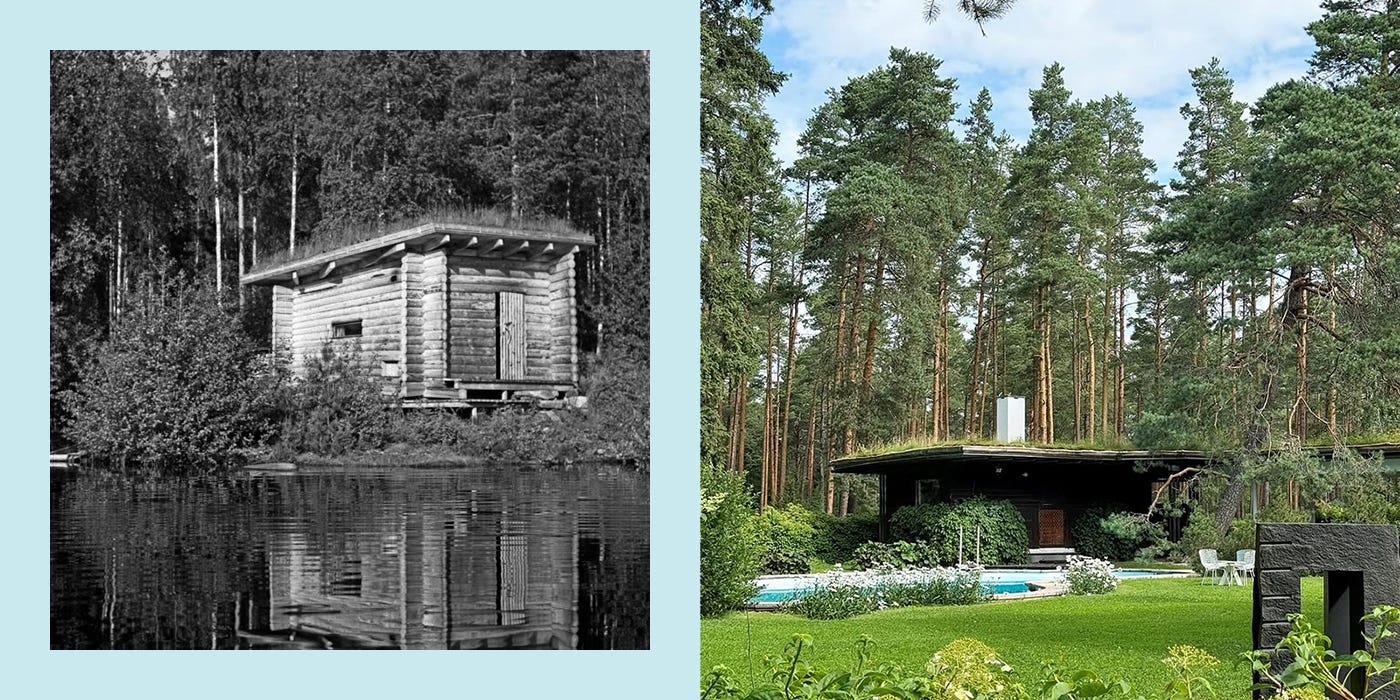
I’m only familiar with the rough-cut standalone sauna on the property of Aalto’s “experimental” summer house and the one with the turf-covered roof at Villa Mairea (both pictured below). You saw his lesser-known everyday one at his primary house in Helsinki earlier this year… Can you describe?
Sami Reiss: Yes—on the tour of his Aalto house, in the Munkkiniemi neighborhood of Helsinki. The place itself was not unlike Corbusier’s atelier, restrained, dialed in to the very last door pull. He had a sauna as sort of the first floor, under the office, I believe; the living room and kitchen a bit more sunken. The guide said most houses in Finland and in that neighborhood have saunas. Akin to a porch in the south. We didn’t go in.
Which leads to my real question—do you think there’s a difference between a sauna that flexes architecturally and one that gets the job done? Workhorse vs. show pony?
SR: Part of me says no: there’s no difference, really, between a sauna that just gets the job done, which is through dry heat, and one that’s beautiful. But that’s my jock bias: there’s definitely a shot that a more beautiful experience is more immersive and complete for someone else. But that question also shows the beautiful set of design decisions in these workhorse saunas. The best and simplest ones are purely functional and elemental: wood, heat, enclosed space. The tech is pared back and the build has an almost Bauhausian philosophy behind it: function, no adornment, and a rough strict form. It’s beautiful enough. But again, that’s my bias.
I think the principles of rudimentary sauna design are so perfect that newer design decisions and aesthetic interpretations don’t touch the function; they only offer a snapshot of the era and inputs (the designer, the country, the cost) in which it was made.
KK: One could certainly argue that all the new-fangled extras are just adding noise to what is meant to be an elemental experience. (A Wifi-connected sauna…? Truly?)
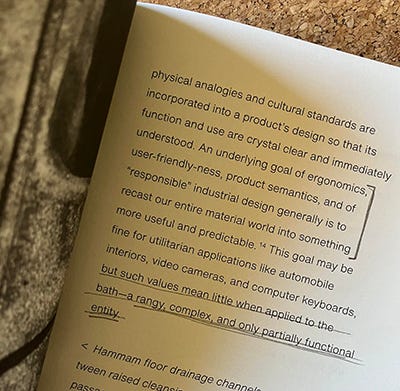
Ultimately: Can you unlock a more transcendent experience vis-a-vis design Leonard Koren (reference: Undesigning the Bath) would argue that capital-D design can actually detract from the bathing experience…
SR: Truly great question. Design can probably be transcendent for a real design lover—who am I to say it’s not? But without having read Koren I’ll half-agree with that statement: design may sometimes detract from the sauna experience by interfering with such an eternal process. (Though it might not always.)
KK: That book made me consider the bathing experience in a way I wouldn’t normally. I’ll be honest—my ideal bathing environment is super-functional, hyper-rational, basically a room you could hose down that you don’t spend much time in. So for me, the sauna, the outdoor hot spring, this kind of environment is categorically different and sure, might suffer from over-design.
SR: As far as transcendence… I think it’s possible indoors, like at an old European church, or duomo, and maybe the right gym (for a split second), or an old concert hall or movie theater, but it’s not the design that does this—it’s time, it’s some unnameable thing. I think transcendence mostly happens outside. What’s neat is saunas are so different from most indoor experiences: it’s a rare… inside activity that activates the body while keeping it inert. It’s exercise, but it’s not.
You live in New York. Have you been to any of the branded “wellness” spaces opening there that are marketing saunas/bathhouses similar to how fancy gyms were being marketed ten years ago? I’m talking about Bathhouse, Lore, Othership. (Similarly, ARC in London.)
SR: I’ll confess I haven’t. I don’t have a problem with these places—they’re instances where the product they’re selling and marketing is so great to begin with that it’s inevitable it would be offered at an expensive tier. Ultimately these take you to a priceless plane: HEALTH. But though I love the banya, I’m not the most consistent consumer. I go now and then, but not regularly; though this convo is priming me to do it monthly this fall and winter.
What’s your take—are these more for wellness, or more for the social aspect, as what those in the urbanism business might call a “third space”?
SR: I think these more branded and upscale wellness spaces can indeed be third spaces—lots already are, like run clubs and expensive gyms. I suppose those are exclusionary: but many free third spaces traditionally have been, too. As for their increase in popularity: some of this is incidental, some is on purpose. Really, wellness spaces—expensive or otherwise—are ascendant because there’s a mass appetite for the recuperation they offer. A sauna like Lore’s is really a tool for a white collar worker who has mortgaged/atrophied their bodies for their jobs, to make it through the workweek. (Not to mention their headspace.)
It’s spoilsport to say you can get just most of the benefit of an expensive wellness space for cheaper or no money—but it’s also a nice way to take power away from these places. There are a million ways to get healthy and hang out with people. I often think about how at a very meager, dingy chain gym in Chelsea that I lifted at for years, the same people would hang out there for hours. It was such a dump. And yet there was a crew there every day. It’s probably even more fun somewhere nice. The dearth of third spaces in American life is what’s created this vacuum.
“The dearth of third spaces in American life is what’s created this vacuum.”
OK, since we first talked about doing this, I’ve read a raft of trend pieces on our humble sauna. A couple of things to note… For one, it’s coming up frequently as a travel amenity. Would this make you seek out a hotel or book one specifically? And based on what you know about the health benefits of the sauna… have we found a cure for jet lag?
SR: I don’t think I’d book a stay anywhere based on health amenities: health is already decently incorporated into my work life—I wear yellow glasses on the computer, I find time to work out regularly, I eat decently, I walk—that I actually look forward to changing my routine on vacation… being more lax and taking a diet break, not lifting. That said, most of my trips lately have been to Europe—better food, tons of walking, swimming—or Canada in the winter, with brisk air. I’d certainly try it, but I ultimately believe people can feel rejuvenated and brisk even at a Marriott. All you need is some mineral water and push-ups.
As for jet lag—yeah, it can be beat. Or attenuated. One way is to titrate your hours ahead of time: wake up at 5 AM before your flight to Europe. Manipulating blue light and sunlight makes a dent. Dehydration and mineral depletion, let’s say—the exhaustion that comes from flying—also doesn’t have a big body of clinical work around it, and so OD-ing on vitamin C, magnesium, potassium, seafood… all of that can make a long flight less taxing. That said—the Bay Area to Helsinki flight is the ultimate test.
KK: You can clearly see where I’m going with all this—literally and figuratively.
Kind of travel-related, and very Aalto-related: Did you see that Finland approved the conversion of Paimio sanatorium into a “wellness hotel”??
SR: Yes! I went there on a junket (same trip as Aalto’s house), and covered the preceding announcement meeting a couple years ago, which was at the Finnish consulate in Manhattan. (The developers there were asking the most insightful and in-depth questions.) It’s funny—the premise behind the conversion here really matches up with what you alluded to in your previous couple of questions: the owners (and Finland, and Helsinki) are looking to cash in on the luxury health traveler market. There’s a whole structural component involved: easy access to Paimo from airports, testing out different vendors, I believe some tax help. It’s because there’s a big, big market of well-to-do people who fly all over to experience different spas and the like.
As for the execution, I hope the new vendors will keep all the details in the original sanatorium: it really would be an explicit example of design and health existing together. It really runs counter to the hideous, hideous gyms and spas in this country.
Switching gears. Mobile saunas are also kind of a thing, and you see these everywhere, especially in more DIY builds. I have a hard time figuring the use case for these—why wouldn’t you just build a stationary one?
SR: Hmmm. Maybe the use case here is for a business or activation, or if you’re a renter? A mobile sauna feels like more upkeep, and maybe more prone to breakdown. But I will say: a middling sauna is better than no sauna. I do think there’s a buddy comedy to be made about a sauna timeshare among friends that’s gone wrong.
Would you ever attempt to build your own sauna—why/why not?
SR: Now as in today? Wow… maybe? My building has a couple of shared courtyards, and with the right presentation maybe they’d let me throw a sauna in there. But I absolutely would if I were living somewhere where I could. It doesn’t take much space, does it? Or even expense.
KK: Well, the price of cedar has skyrocketed with Canadian tariffs, but generally speaking no. Cheaper than buying a Kohler one. :)
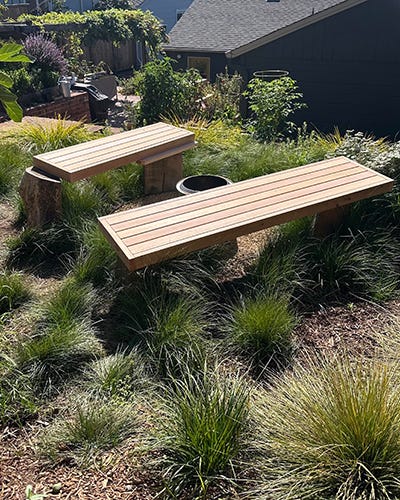
SR: My trip to Finland was an eye-opener: Saunas were everywhere. Everyone had one. Simple, small, middle-class homes. There’s no big impediment here in the US for a normal person to have this amazing tool. Now I am thinking about a backyard or gym with a sauna and a nice calisthenics set-up…
KK: Yrjö Kukkapuro told me when I interviewed him years ago, that he and his wife did calisthenics outside every single day. He must have been pushing 80. Point for Finland again.
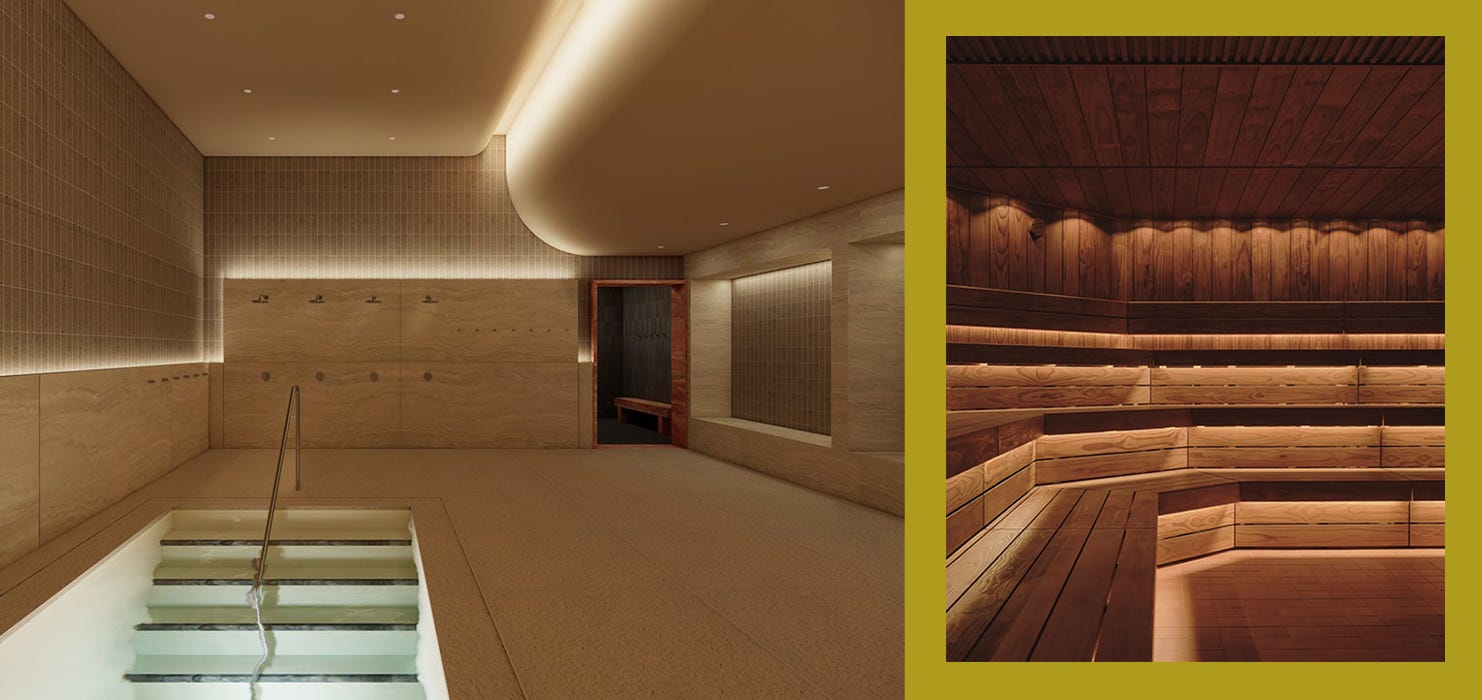
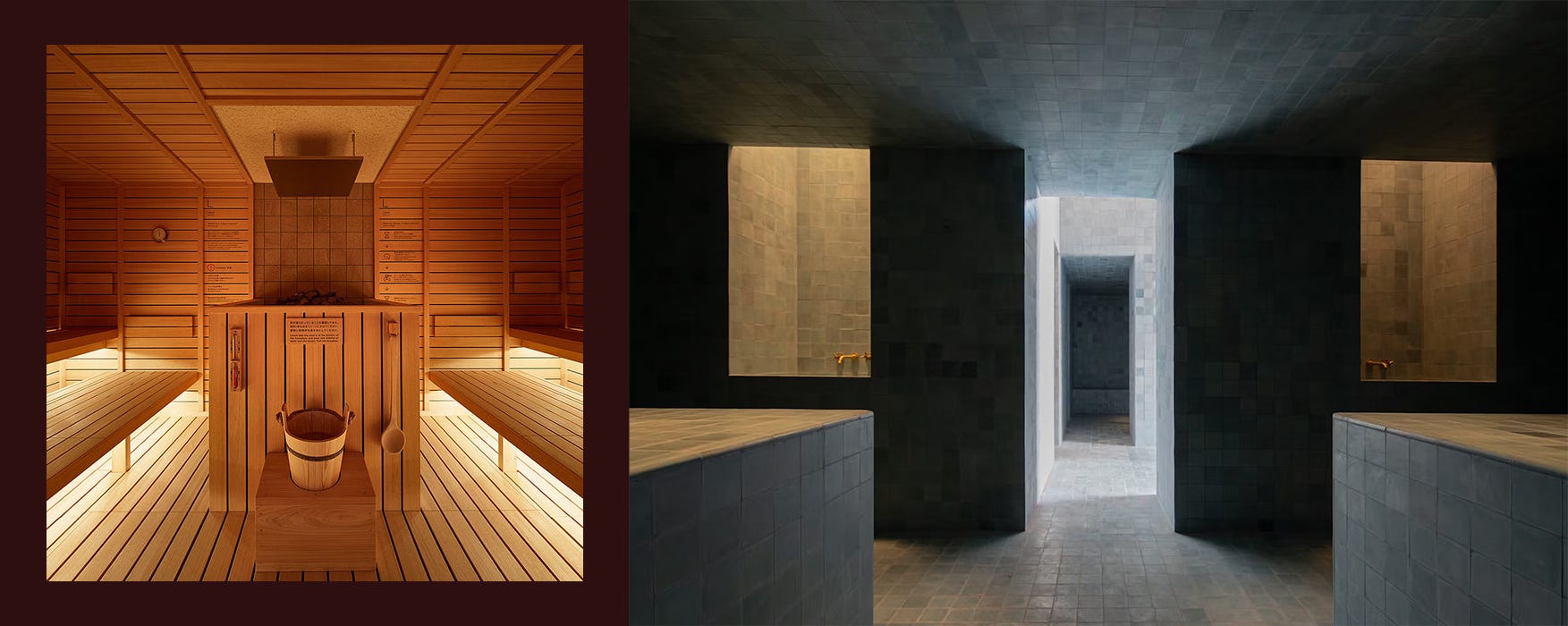
And finally, here are some just plain gorgeous saunas. Please rank on the Sami Scale:
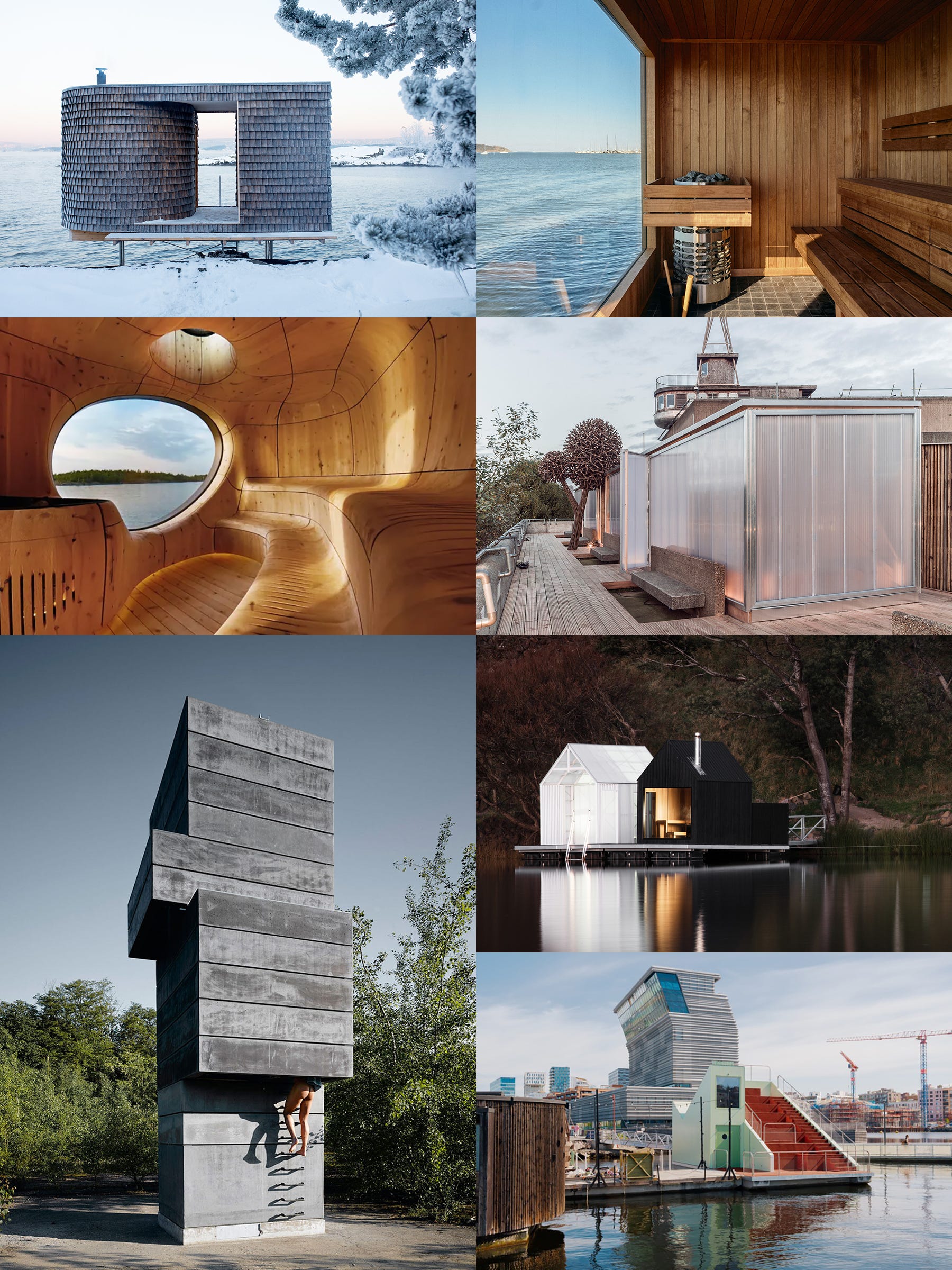
SR: This is tough: so many of these are outside my aesthetic or preference: I’m so psyched to see a sauna that I don’t really get critical about the design. But let me say… the Partisan sauna first, since it’s in Ontario. And then the one-man modular sauna, since the stairs feel like a workout and I like the idea here of getting all that sun. Then the Fjord—seems like a fun thing to do for an S.F. trip—let me work that in before we get a coffee on my next trip. Then Oslo Works after that—it feels very frigid outside—then Trosten in Oslo as it would be fun to jump in the water. And the Derby and London ones taking up the rear, but barely—this is a photo finish.
I’d do any of these over whatever I’m doing this weekend.
Many thanks to Sami Reiss! Make sure to subscribe to SNAKE—the best design/auction roundup around. And for the dedicated Sami super-fan, his Substack SNAKE SUPER HEALTH is a wealth of info both reported and personal.

Odds and ends
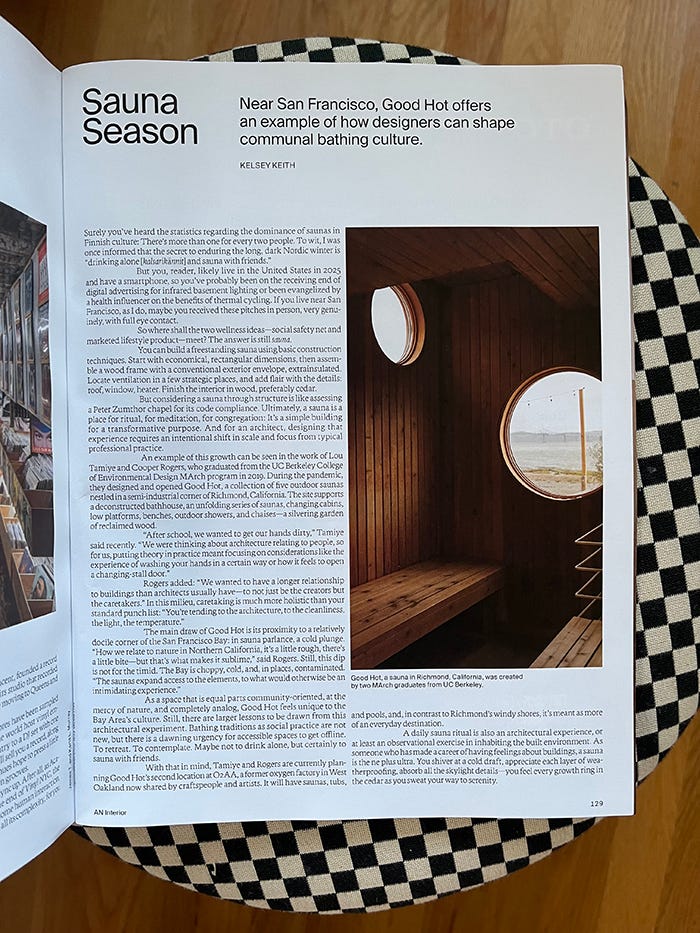
My story on saunas as praxis in the field of architecture—featuring Bay Area treasure Good Hot—is featured in the October issue of AN Interior mag.
Don’t sleep on GC pal and international It Girl Marisa Meltzer’s guide to bathhouses around the world (“Lets Get Wet and Sweat”)
Since last writing, the New York Times has published at least three more sauna trend stories.
And ICYMI, I wrote a dispatch on bathing like a local in San Francisco for Culture of Bathing, covering everything from the aforementioned Leonard Koren to the floating sauna in Sausalito everyone’s raving about.
New Bottega Veneta creative director Louise Trotter tapped local Venetian glassworks 6AM for those irresistible Murano glass stools shown at her first fashion week presentation.
People are finally noticing that RH and its CEO seem to, ah, spend a lot of money?
Davide Biancucci curated an exhibition of canvas folding chairs for Campeggi in Milan—a sentence that sounds far more boring than its actuality. I am a sucker for a typology show, and Biancucci is a researcher whose eye for compelling, under-the-radar archival design is nonpareil.
Up next in Ground Condition’s only annual Sauna Month: a play-by-play of the custom sauna I designed for our Berkeley backyard. If you haven’t already, subscribe now: