The Grit with Caroline Cai
On zoomer art, catalan chicslop, and grace through humiliation
The Grit is a Club Reticent series where I have beautiful conversations with my favorite women about their creative lives – unpredictability to craft.
Caroline Cai first entered my periphery through the Nymphet Alumni podcast. She appeared on their Catalan Chicslop episode, where the girls dissected what lies behind the Gimaguas-ification of fashion with smooth beige fabrics and tired, unexpressive eyes reigning our screens. Caroline’s deeply anthropological and critical curiosity for the world piqued my interest, and I knew I had to meet her. We engaged in the kind of parasocial alchemy that happens when two girls with big interior worlds meet on the internet. The rest is history.
Today, Caroline walks me through her maze of a beautiful mind: we talk about what constitutes the Caravaggio-esque Aidan Zamiri aesthetic conquering every medium, the importance of Zoomer art, being intrigued by sameness, Ivy Wolk, and how there’s never been a better time to be a girl poster than now. Caroline also breaks down the contemporary version of an EGOT, which –allegedly– includes being a guest on Nymphet Alumni and having a Club Reticent feature.
Valerie: I’m very grateful that the podcast brought me to you. Please introduce yourself to those who don’t know you.
Caroline: I am a writer. I have more recently delved into fiction and poetry, but my favorite medium is the bespoke, non-fungible, critical essay synthesizing various art, cultural and internet phenomena with semiotic and affect theory.
Valerie: What’s on your mind lately, Caroline?
Caroline: Broadly speaking, the art world is obsessed with neoliberal aesthetics of AI and surveillance, pop music is still obsessed with Y2K, and film is obsessed with higher brow pastiche of its even older 70s, 50s cannons – which makes sense given the production turnaround rates for each of these mediums, as if the greater expediency with which you can make something, the greater its capacity to reflect the contemporary moment.
I believe that writing, since it can be utterly reflexive and spontaneous, can experience its own consciousness in a way that’s totally modern in perpetuity.
Valerie: I do feel we are increasingly seeing more of the same across different mediums, online writing being merely the latest victim of growing production volume.
Caroline: I am sort of intrigued by sameness. I am interested in how people can speak to the masses, and finding the kernel of what is avant garde about sheer volume and ubiquity, and how commercial, replicable models are produced. I am in awe of how pop stars can manipulate the cultural consciousness into a horny or war-like or down bad state. Right now, this sense of sameness is manifest in a new aesthetic coined by Ella Dorn that is often coupled with Catalan Chicslop, called Giallobrutalism.
Valerie: Tell me more about Giallobrutalism.
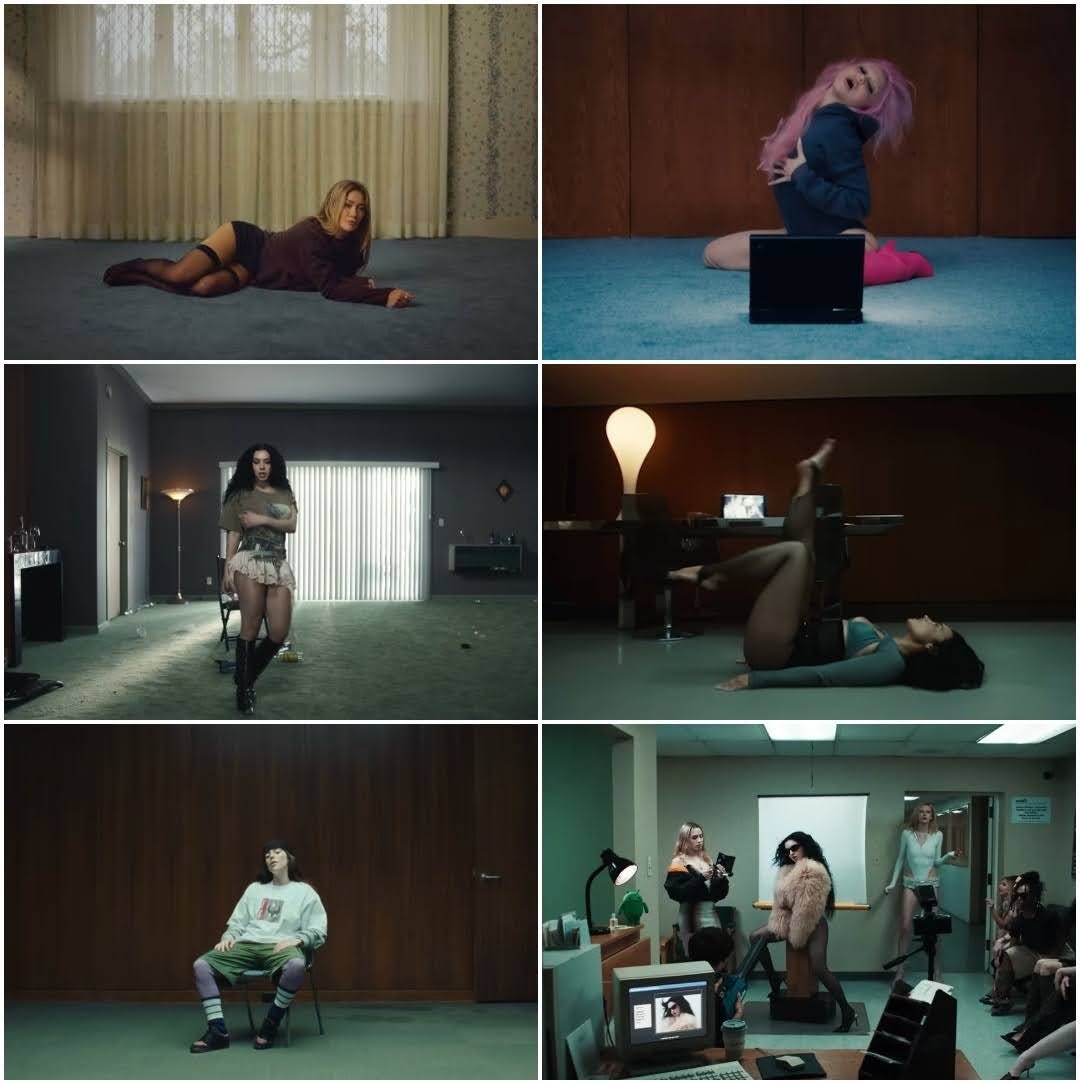
Caroline: I feel like Giallobrutalist Catalan Chicslop currently has a sanction on “cool pop aesthetics”. It’s both fetid and sterile, vintage and sleek. It’s a dead-eyed pop star dressed in Paloma Wool in a low-lit, sparsely furnished, vaguely mid-century showroom or office set with wood paneling and turquoise carpet. Compositionally, there are Caravaggio-esque bodies, lots of negative space and voyeuristic camera work meant to signal surveillance anxiety. The coloring is very muddy and cool toned. The most textbook example is probably 360 by Charli XCX. It’s the signature style of Aidan Zamiri and Imogene. I think they’re trying to distinguish themselves from the hegemonic corniness that is Taylor Swift’s ME! music video – candy technicolor, CGI magical realism and cheugy dance numbers – or the vulgar maximalism of K-pop, but in this process of differentiation, they land on something that is visually appealing but feels quite dead.
I have also observed what feels like the masculine, spiritual counterpart to Giallobrutalist Catalan Chicslop. It’s depicted by post-covid films and shows like The Curse, Eddington, On Cinema, The Code, and Nope. It’s like a prop stucco Southwestern town or Coney-esque Island, Home Goods indigenous Airbnb, botched construction site, urban desert planning, exposed Brechtian set, HGTV or man-on-the-street mise-en-scene, white collar conspiracy, sunny, cerebral horror, “TikTok and gentrification comprise all of reality”, techno-pessimistic cinema.
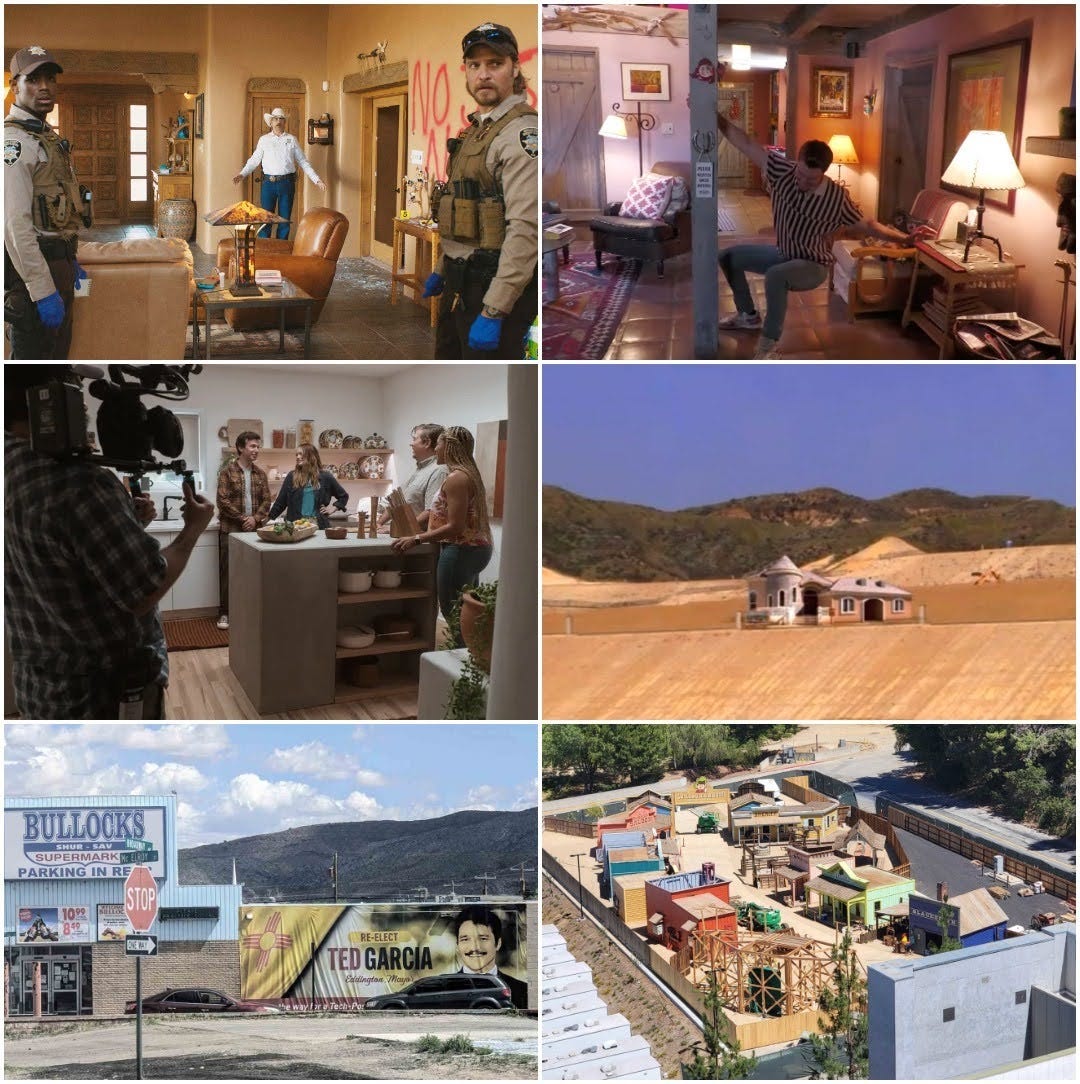
I am not saying these works are slop, there’s just a through line that cements into a micro-movement.
Valerie: It feels by striving for differentiation and authenticity at all costs as the end goal, we end up eating our own tail. We’re all stupidly the same!
Caroline: I think that a lot of people think that the answer to the crisis of authenticity is to champion “Zoomer art”, but I can only ask questions - what do they actually mean when they discuss “Zoomer art” or literature? I think what people are actually trying to get at reminds me of the discussion surrounding “What is queer art?” - it’s not necessarily work that features queer characters or engages queer topics or is even made by queer artists. It’s not necessarily a string of signifiers. It’s about rejecting linearity to capture a sense of immanence, as if new realities can cascade and splinter off and get destroyed at any moment, which is literally not for everybody and not always good. But I think that it’s a jumping off point. I think what they’re also actually trying to get at is a concept of auteur art, where the idiosyncratic worldview of an individual is instated through a piece of art. I think a lot of people also equate “Zoomer art” with a specific art movement that appropriates the aesthetics and temporalities of the internet and AI, but I think that’s more subculturally than generationally specific.
As a proud Zoomer who deeply reveres our generation’s minds and art, I think that we can be as nostalgic and milquetoast and literalist as anybody else. So I think that we just need to create better cultural and labor conditions for art without necessarily setting genre qualifications or worrying about notions of authenticity, which I think no one can seem to define anyway. At the end of the day, it really comes down to Marxism.
Valerie: As nihilistic as we seem to the world, I’ve noticed that a lot of us (gen Z) are more preoccupied with what older generations think of us and our art, as opposed to just creating.
Caroline: Yeah, I think that people are having trouble knocking down institutional barriers where older generations still hold the keys and are worried about profit returns above all else.
Valerie: Is there hope?
Caroline: There is. I think that’s just the timeless dialectic. The rot is neverending, but so is the love and the beauty. I actually don’t think there has ever been a more exciting or fruitful time to create. I think that AI and corporate slop ubiquity will actually, inadvertently, spur the most beautiful avant garde movements of our time. I think that people will be hungry for laborious, humanistic forms of beauty and virtuosity that are reminiscent of baroque movements, but also feel totally novel, as everything around them becomes tinged with a sheen of techno-alienation.
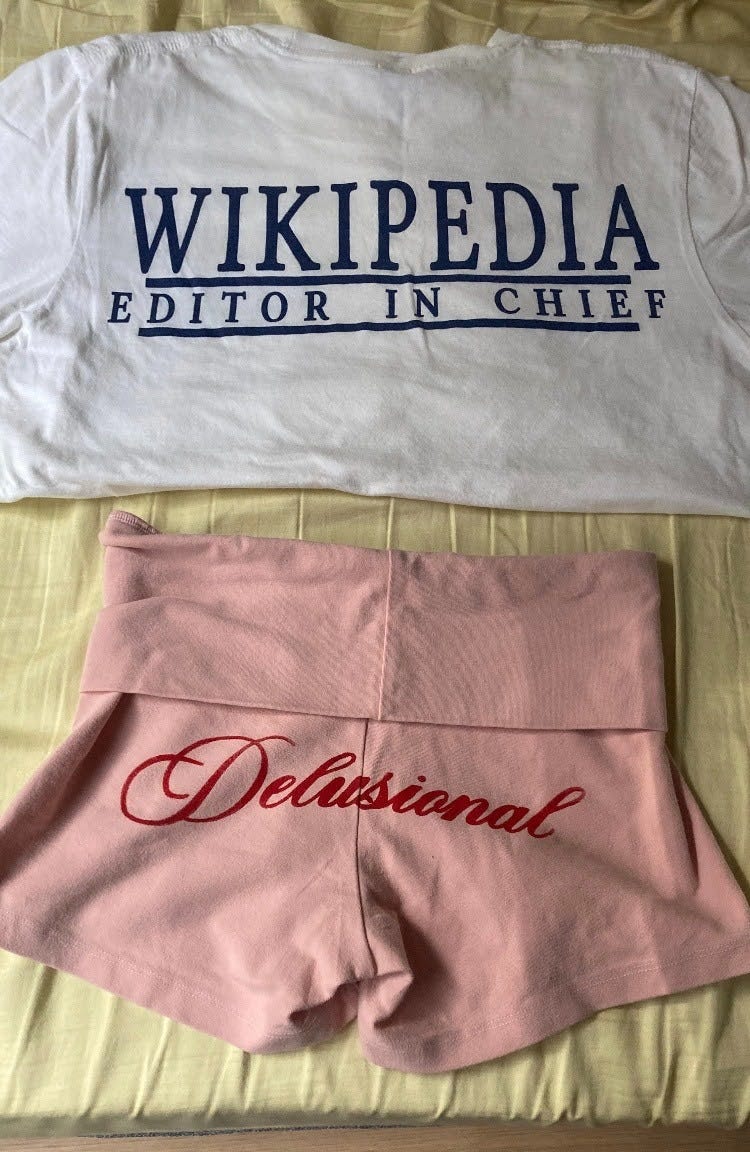
Valerie: I agree with you, but as a writer, I can’t help but feel frustrated with how outdated and low-paying both publishing and legacy media are.
Caroline: Every creative industry is dying, but if you think about the shrinking pool of people who listen to music outside of Top 40s, an even smaller pool of people make it out to the movies, and then an even smaller pool of people will read an entire book within a year. I think because writing is so non-commercial, it hasn’t even dwindled into a cottage industry, it’s more so like a glorified scene, and we keep the practice alive via readings, independent magazines and Substack. It’s really this bottom-up, DIY culture. We are sort of fringe, just by way of how small we are, not even because the content is alternative in terms of genre.
Valerie: To be honest, I think Substack is also up there today with the lowbrow get-rick-quick posts and essays by people who don’t read books.
Caroline: I understand. For a while, I was so fatigued with discourse and culture industry slop that I only wanted to operate within the non-representational spaces of poetry and fiction because it seemed like contemporary discourses didn’t take into account the incidentalness or sensuality of real life or bestow the individual with any agency or charm.
That’s why I love your work, because it’s so embodied and it takes these factors into account amongst the backdrop of more systemic, political forces. There was a time where I was desperate for audiences to bypass these discourses to become attentive to beauty and form. But then I swung too far in the other direction and got fatigued with DIY avant-garde stuff and thought, this is so allergic to gagging it, and there really isn’t anything better or more embodied than Famesick by Lena Dunham.
I think that a lot of staggeringly good, original work is being made. You just have to seek them out and not default to what is being marketed towards you by massive studios or labels or the algorithm.
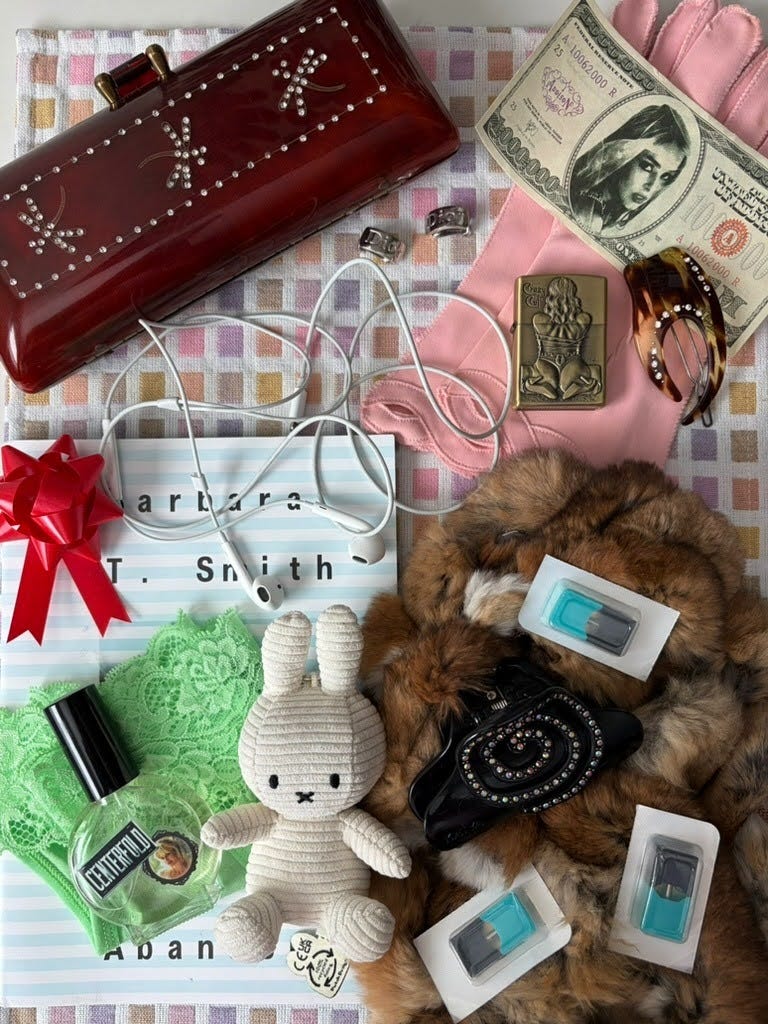
Valerie: That means a lot to me. Who are your favorite creative women?
Caroline: I love Olivia Kan-Sperling, audrey robinovitz, rian phin who is a fashion anthropologist, the Nymphet Alumni girls, of course, Molly Soda, I love this writer named Safy Hallan-Farah. I recently saw a great short film by Daniela Rodriguez called Finding Lana and another called Does That Hurt the Fish? by Dahlia Bloomstone. My favorite posters who are also artists include Ivy Wolk and Yoona. I also love Bunny Rogers, Bogna Konior and Sophie Becker.
Valerie: I identify as a girl poster as much as a writer. Can I be both?
Caroline: Yeah, I think that you’re a bona fide writer. The effect a writer is supposed to bring about is accomplished through your work. And I think that it’s more about the affective relationship between the writer and the reader instead of any traditional benchmark.
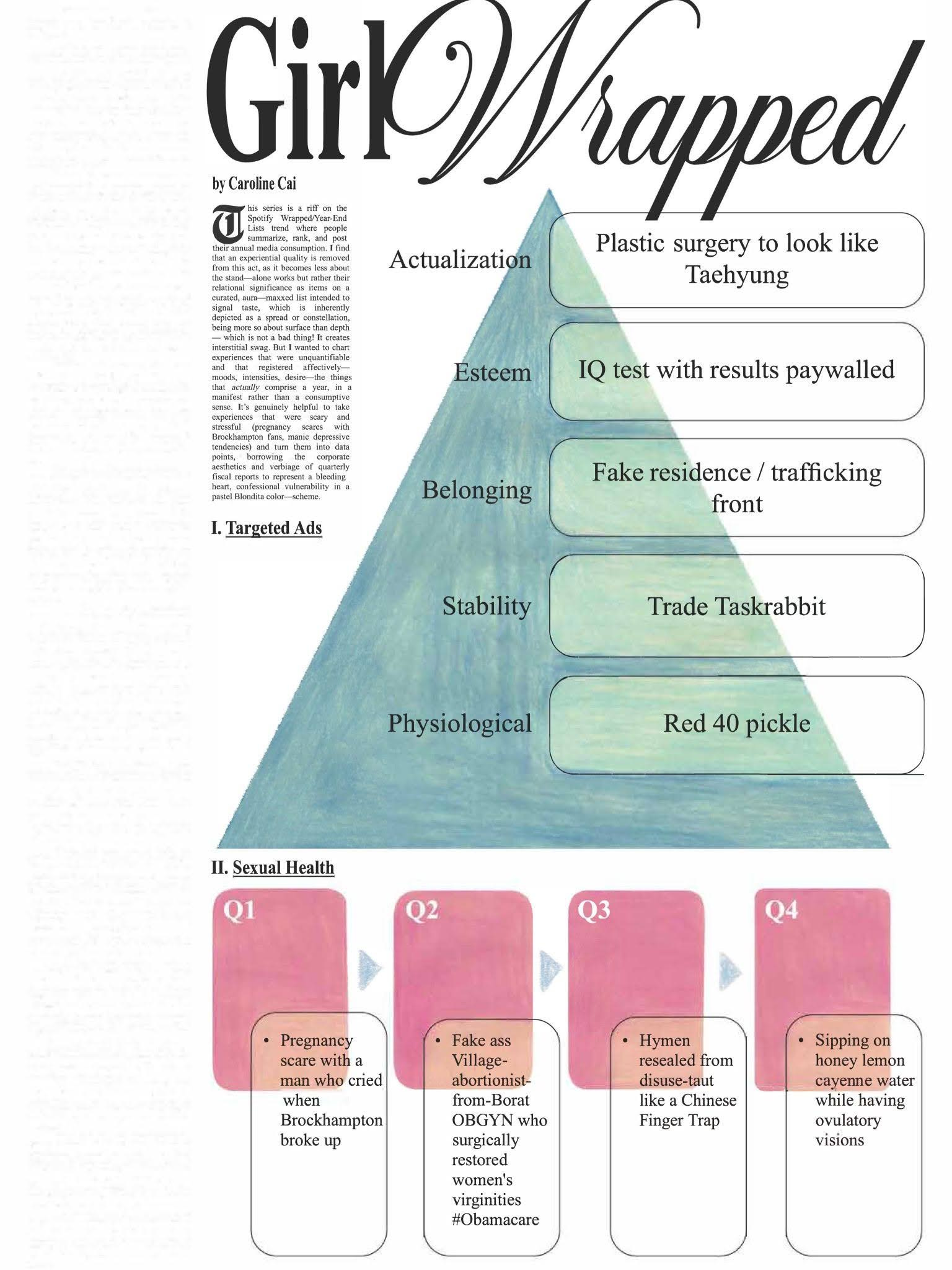
Valerie: That’s a nice way of looking at it. We can say all these horrible things about the internet, but at the end of the day, I appreciate how reachable it makes you and your work. Being a girl poster in 2026 is probably the best time to be one – becoming famous off that alone would be a miracle. What do clout and cultural capital mean to you?
Caroline: I think even having any meta-narrative about it on your conscience is so antithetical to the work. I’m going to sound corny and overzealous for a second, but it’s important, I believe: it disturbs me that people are having a remotely self-conscious or non-theological experience in a space meant for gathering to witness art. Inside the walls of these artistic spaces is a vulnerability and contagion of spirit, and outside is where beauty goes to die, where vampiric corporations attempt to stifle any semblance of what makes us thinking and feeling beings, and that’s how I’ve chosen to look at it.
To walk into space like that and mistake accumulation for life, to collect tokens that are redeemable for nothing, to be hollowed out by metrics, to manage an outsized image and address an abstract “audience” while remaining lonely and demoralized as ever is a state of profound alienation, the kind of alienation that art and community should liberate us from. I also find that 95% of people I meet in these spaces are really kind, sincere, and nerdy.
And another thing: I really think that the unease with clout is oftentimes misogynistic. I think it’s a thinly veiled excuse to discredit a woman’s merit. And I’ve also stood on the fact that when a man uses the term “art hoe,” it’s a slur. Men will say lit hoe, art hoe, film hoe, and it’s thrown around to dismiss a woman’s practice instead of just referring to her as a writer, a director, a designer.
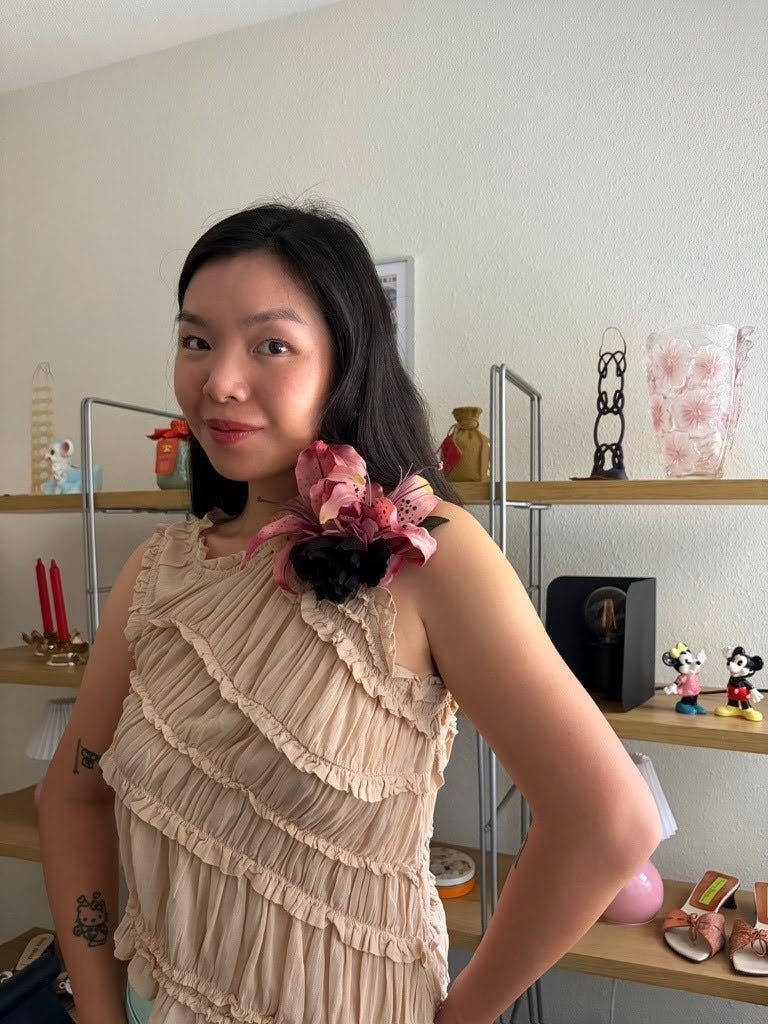
Valerie: I only refer to myself as a young ho.
Caroline: What does young ho mean to you?
Valerie: Ivy Wolk is a young ho. It’s more of a state of mind. She is free and uninhibited and in charge of her narrative.
Caroline: I love that. I didn’t know there was coinage for this sort of archetype, and I identify as a young ho. I think this sort of grace-through-humiliation approach that Ivy Wolk and my favorite young women embody is a virtuous way to live.
It is the art of loving without defense, giving everything away, word vomiting, being totally transparent and guileless and non-strategic, finding grace through humiliation and failing upwards. It’s realizing that security can never be gained, but it can always be chosen.
There’s so many trendy, internet native social concepts dealing with fickle matters of the heart that try to marshall our emotional lives, like “that girl” or “higher self” routines or attachment styles, etc. But I think that my life can be subsumed by this grace-through-Humiliation framework that is kept in check by my Virgo and Aquarius placements, because you have to know when to reel it in. My friend Nicola gave me great advice, which is that you don’t need more grace, it’s all within you. And that’s how you can avoid some humiliation.
Valerie: I love this. What are you working on right now, and what’s next for you?
Caroline: I’m working on two long essays for two great publications. Without giving too much away, one is sort of a written, art-historical extension of my Chicslop podcast and another is on replicas, forgeries, and reenactments. I’m also writing my book which won’t be finished until 2027.
Long-term, I have ambitions to conquer every sort of form that has been around for ages and that will always be relevant: the novel, the film, the play. I’ve already checked off podcasts and Substack interviews. It’s like the contemporary version of an EGOT: Nymphet Alumni, Club Reticent…
Valerie: What are the other two going to be?
Caroline: Maybe bylines in a lit mag that only publishes whenever it feels like it. And a create mode story screenshot that goes viral.