My Original Immigrant Ancestor Has an Insane Origin Story (With Pictures)
He fled Ireland with a bounty on his head and became an American general.
I generally find family tree stories to be tedious and boring, “I’m 3% Irish, 2.62% Dutch…”
People think their story is more interesting than it actually is.
Mine might be an exception — but I’ll let you be the judge.
I’m blessed to have access to detailed documents and pictures of my family history. And with them — a fascinating origin story, that’s woven into the America’s own.
This is the short version.
My gritty original immigrant ancestor
William Kernan was 5’10”, strong, athletic, and had a bounty on his head.
He’d partaken in the Irish Rebellion of 1798. Ireland was under martial law. Police officers were instructed that if Kernan were caught — he should be hastily hanged at the nearest tree, bridge, or whatever makeshift gallows could be assembled.
You wouldn’t have blamed William for partaking in the rebellion.
The Irish were relentlessly bullied, tortured, and executed under British rule. They couldn’t own land or vote. They couldn’t carry a gun, go to college, or own a horse unless it was low value.
The British demeaned them at every opportunity. Even without a death warrant, Ireland could only offer William a life of despair.
He scraped together the little money he had, boarded a ship and set off for New York City in 1800. It was a three-masted ship like this one:
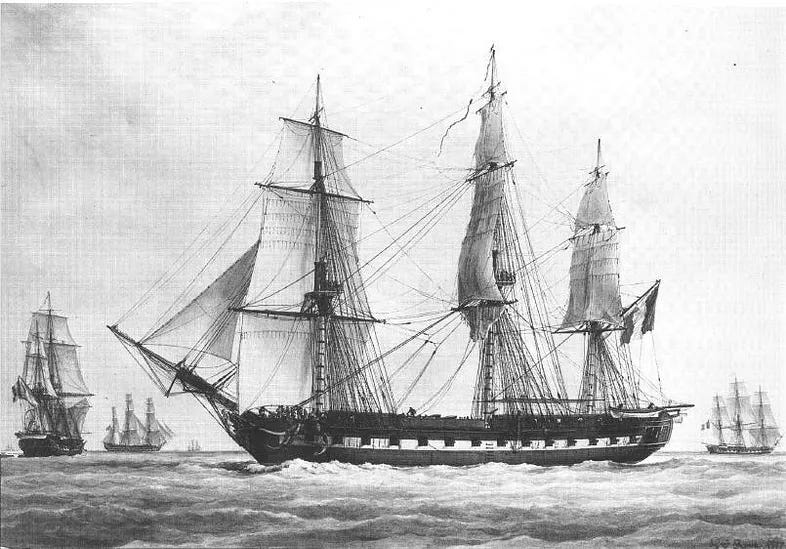
His letters said the ship creaked loudly as it pushed through the waves and sleep was hard to come by. He added that passengers had to bring their own food. And, oddly, the captain kept eating their leftovers, leaving him with more questions than answers.
William and the other men gave the captain a hard time about it. The captain said, “You don’t know what I’ve been through.”
Apparently, he’d been in a shipwreck and was scared of not having enough food and being stranded. This struck the men as a less than ideal thing to hear from their captain.
Two long weeks later, in the middle of the Atlantic, the crew pulled up a 10-foot shark. It stunned everyone on board. Most passengers had only read of such beasts and never fathomed seeing, let alone eating one.
Eventually, they arrived in New York City in the middle of a Yellow Fever epidemic. The city was in quarantine. Everyone was locked down on the ship and unable to leave.
During the trip, William had read of a job available in New York City at a grocery store. He convinced the captain to let him sneak off in the middle of the night.
He worked at the grocery store for two years while saving his money.
Sadly, it was during this time he realized America wasn’t the safe harbor from the bigotry that he’d hoped it would be. There was rampant anti-Irish racism.
Protestant elitism ran strong. The white community viewed Irish immigrants as mongrel dogs.
William had come to America with a singular goal — to own land. In these times, that was the hallmark of achievement and independence.
He took his savings and sailed up the Hudson River. Then he hiked hundreds of miles west through the wilderness of New York.
The US population was only 5 million at the time and there were far more wildlife and predators. The wilderness was not a safe place. Attacks were common.
He found a small community near the Finger Lakes and bought 200 acres of land. He was one of the few white men amongst a thriving native American population.
He built a log cabin despite never having done this type of work. Below is a depiction of it:

Author via family’s book, Sir Francis Kernan
Pre global warming weather patterns
The global temperature was colder by roughly five degrees celsius on average. But this was exaggerated in hot and cold climates.
Winter was absolutely frigid and routinely stayed in negative digits.
William nearly died while walking 16 miles home from an event. Shortly into the walk, a massive blizzard hit. He could barely see or navigate, and the cold began overtaking him.
He shivered in the gusting snow for hours. He said, “I felt a drowsiness coming over me.”
For context, drowsiness is often the stage before you die of hypothermia. It is an odd seduction by death, whispering for you to just, “Lie down and rest for a few.”
He wisely stayed on his feet and made it home.
In one incident, he was riding his horse to a supply store five miles away and began getting chased by a mysterious man on a horse, who had a hood over his head. The man tried to pull up next to him three times.
Fortunately, William was an adept rider and cut the man’s path off each time. He shouted back to the man to ask who he was but got no response.
As a carriage approached them from the opposite direction, he heard the man say, “Who is that?”
The man then veered into the thick brush, disappearing into the woods.
William was confused by the incident. The next month, he read of a series of robberies and murders that had occurred on that very road.
William came to America with the same goal of most immigrants: to achieve a better life for himself and his wife (a fellow Irish woman he met in New York).
From his arrival until his death, he never missed Ireland.
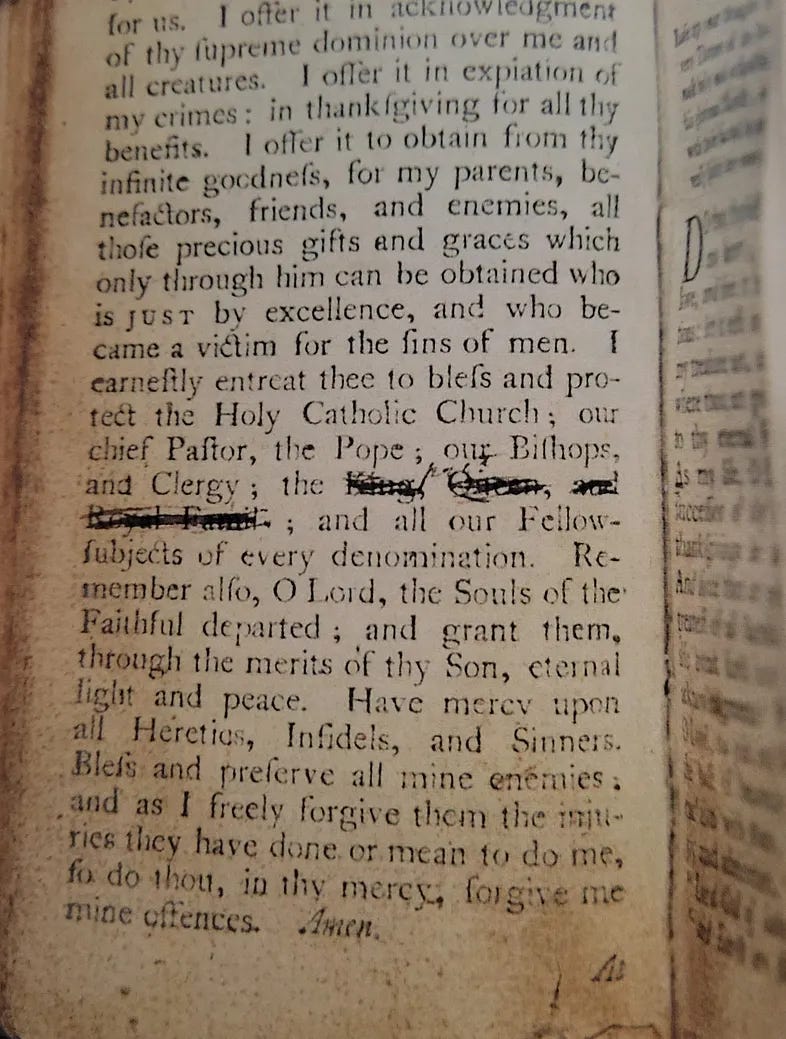
This was evident in his prayer book, where he crossed out the prayer to the King and Queen:
At 22, he joined the militia and proved a formidable fighter.
He fought in the War of 1812 with distinction and in other skirmishes throughout the decades. He rose to the rank of Brigadier General. For the remainder of his life, his family and locals called him “the general”.
The coolest thing (I think) is that he was given a pair of dueling pistols by the Marquis de Lafayette as a gesture of gratitude:
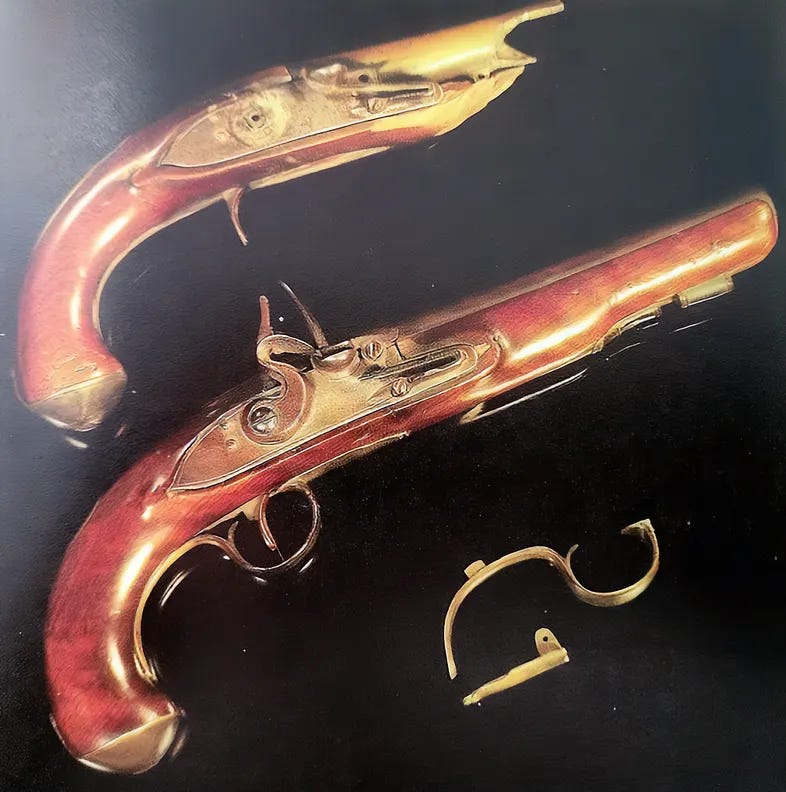
What’s amazing is that the pistols appear to have been used. He lived until his 80s so one can assume the duels went well. It reminds me of the saying, “Beware of an old man in a profession where men die young.”
Truthfully — I couldn’t confirm if they were actually used in duels.
I do know that the top pistol broke because William’s sons were playing with it while he was away. They overloaded it with gunpowder causing it to shatter the front half off when ignited.
I would imagine they got in great trouble over this — or they may have peddled a good excuse to their stern father. I mean, take a look.
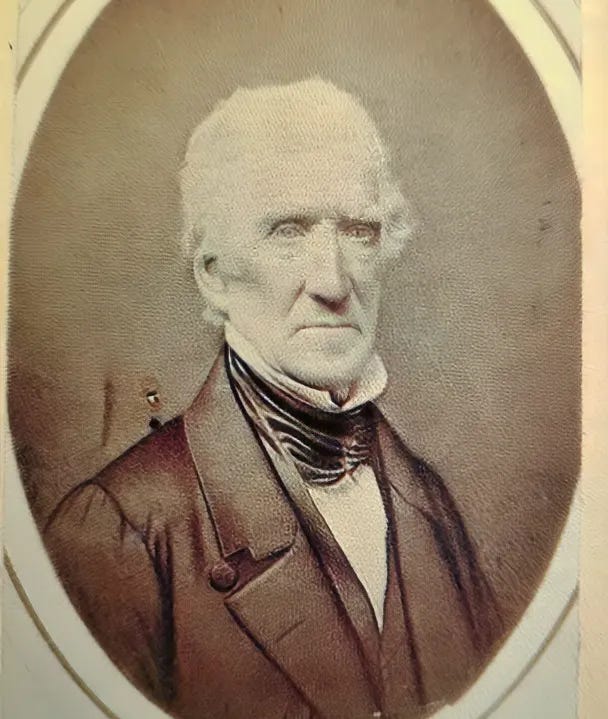
His life was successful by all accounts. He was remembered as kind, generous, and also tough as nails. He had eight children and his oldest son Francis became the senator of New York and a friend of Abraham Lincoln:
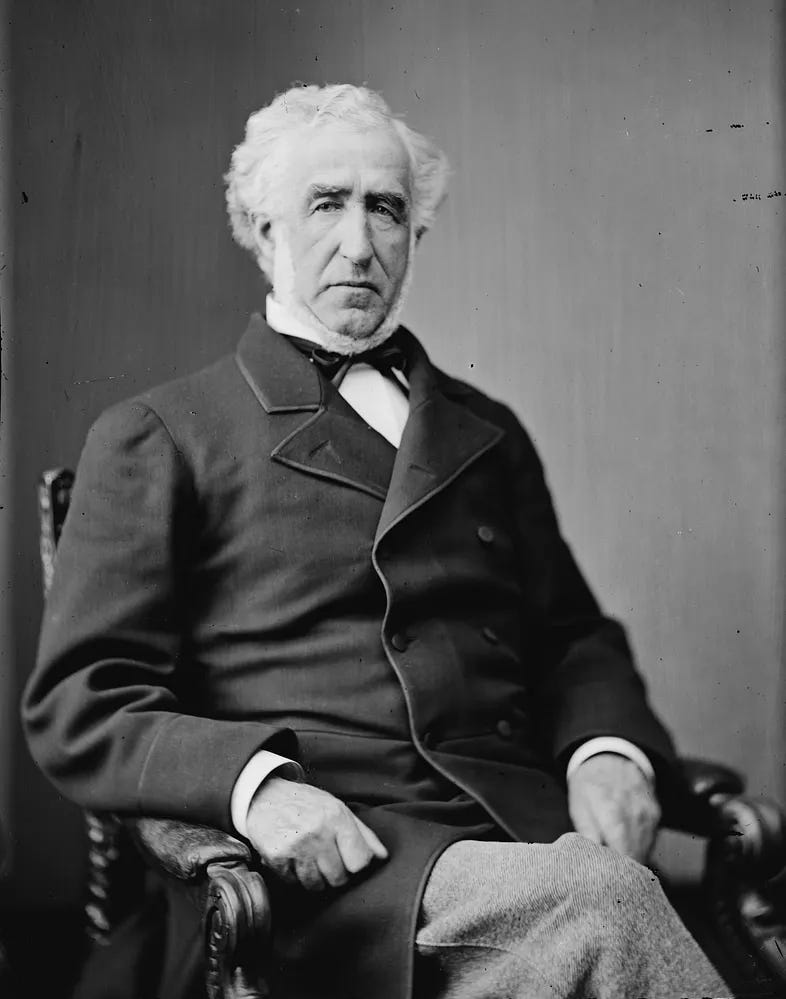
What’s also amazing how physical traits get passed down through generations.
William and Francis’s low eyebrows, long face, and big nose are unmistakably Kernan. You can even see it in my own father:

And perhaps a bit with me too:

William Kernan is my father, Joseph Kernan’s Great³ Grandfather and by extension my Great⁴ Grandfather. Interestingly, both my grandfather and father went on to be military leaders.
This Kernan badass gene skipped me. But it certainly didn’t skip the rest of my family. I see my role today as being a storyteller, helping preserve what I know of my family so that those who come after me can know just as you now do.
When I reflect on all this, it strikes me that America was built by people like William, who arrived with nothing but nerve and, sometimes, a price on their head.
Every family has a story like his buried somewhere. I was lucky enough to find mine.
Now—it’s time to go find yours.
Source/further reading: Sir Francis Kernan by John D. Kernan & Karen Clemens