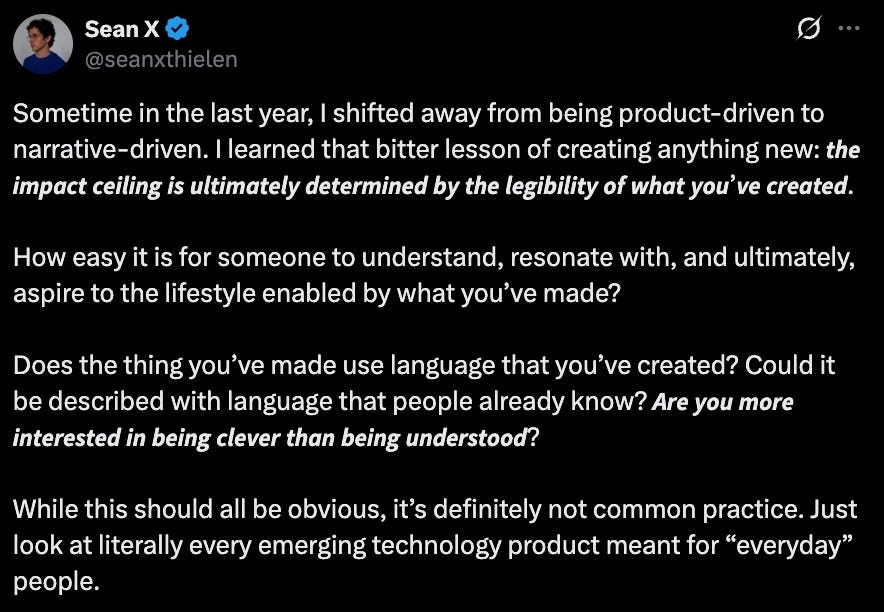
every story opens a world
storytelling is not just telling the story
“Words are events, they do things, change things... ” – Ursula K. Le Guin
Note: this is a slightly different essay from me, at least on the surface. It is about company storytelling and technology, but underneath that, it belongs to the same set of obsessions I keep returning to: language, attention, legibility, and the power words have to make certain worlds possible.
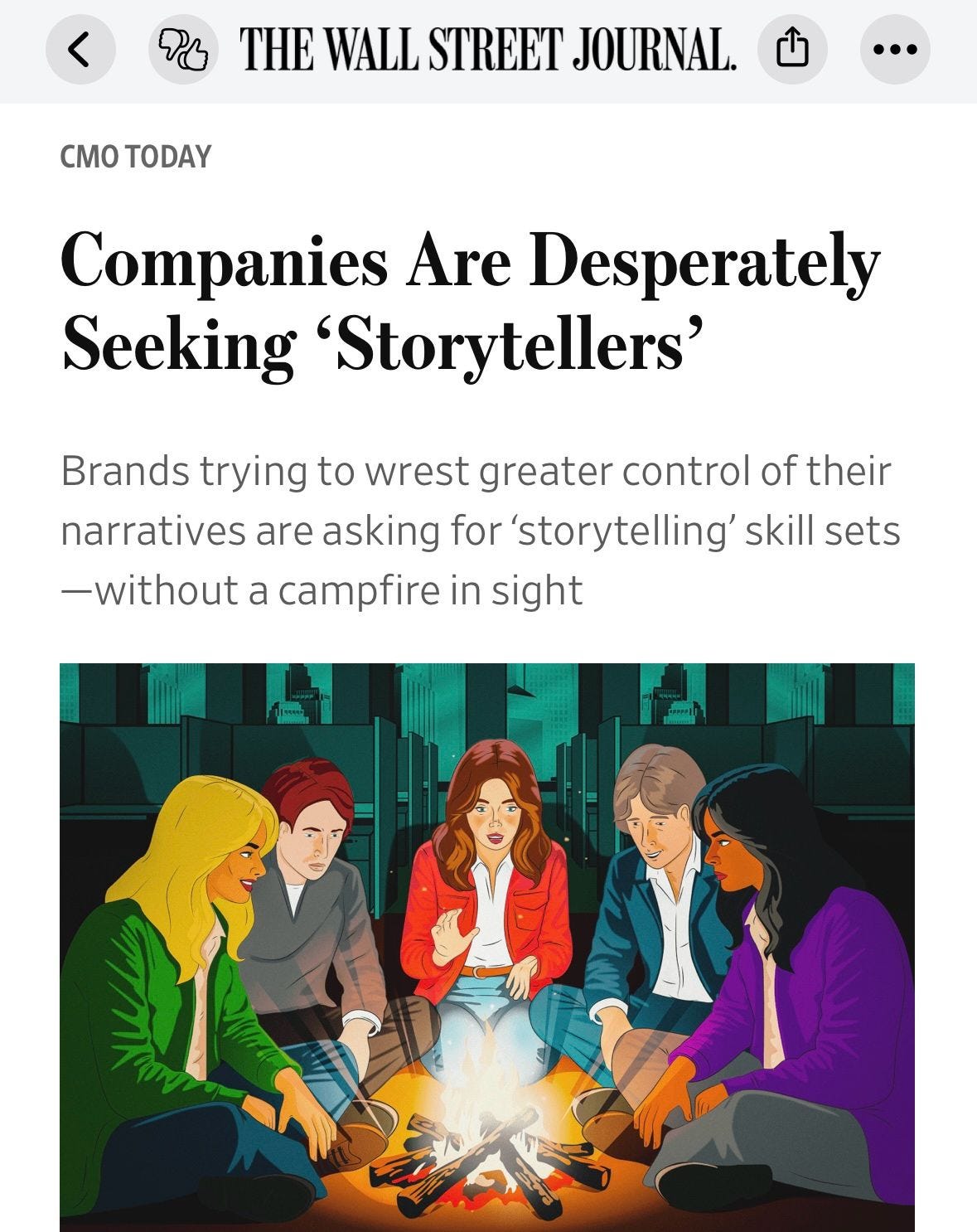
Storytelling is having a moment. Even the job market has noticed. As the Wall Street Journal reported, the percentage of LinkedIn job descriptions containing the word “storyteller” doubled in 2025.
The rise of “storyteller” roles may signal that companies know language matters, but not always that they have agreed on what kind of storytelling work they need. In some job descriptions, “storyteller” seems to mean content creator, founder ghostwriter, comms lead, brand strategist, product marketer, or some hybrid of all of the above.
I find myself thinking of this ambiguity as the difference between the storyteller and the storyfinder. The storyteller expresses an existing story well, translating strategy into words, pages, posts, launch videos, and campaigns. The storyfinder works one step earlier, helping clarify the story before it is expressed: what the company believes, what it makes possible, and what language makes that future easier to understand.
Both kinds of work matter, but they require different proximity to the company’s core decisions. Expression works best when there is already a story clear enough to translate. When the company’s strategic thinking is still fuzzy, the person responsible for the story is forced to reverse-engineer its point of view from the outside.
The stakes become clearer once the story has to travel. As a company grows, its story moves across teams, customers, candidates, investors, decks, sales calls, product decisions, and everyday conversations. Anyone who has played a game of telephone knows what happens to a message as it moves. It mutates and absorbs the assumptions of whoever repeats it.
Rather than just a communications asset, the story is one of the ways a company keeps identity, action, and perception in alignment. What a company believes about itself shapes what it builds, sells, hires for, refuses, and celebrates. Those actions shape how the outside world understands the company. That perception then feeds back into who joins, what customers expect, what investors reward, and what future actions feel natural.
At its best, storytelling can both carry a company’s message into the world and help clarify the future the company is trying to make visible. The rest of this essay is about that second kind of work, or storyfinding: finding the language, metaphors, and questions that make a new world easier to see, desire, and join.
the right words make people yearn for the sea
The first task is making that world feel worth moving toward.
An ambitious company building something genuinely new asks people to do much more than understand a product. It asks them to believe in, work toward, and make decisions around a world that does not fully exist yet: investors suspending disbelief, employees leaving safer jobs, customers changing habits, journalists paying attention, early believers tolerating the period where the thing is still unfinished and easy to misunderstand.
People need language before they can take an unfamiliar idea seriously. They need a frame that makes the odd thing nameable, the risky thing meaningful, and the non-obvious thing easier to understand. Language gives people a way to hold the possible before it has become obvious.
From there, understanding has to become desire. A new world has to become visible before it can become desirable, and strategic storytelling helps people understand why the world on the other side might be worth moving toward. This is storyfinding: looking past the product description toward the world the product makes easier to enter.
As Antoine de Saint-Exupéry wrote: “If you want to build a ship, don’t drum up the men to gather wood, divide the work, and give orders. Instead, teach them to yearn for the vast and endless sea.” The best company storytelling works in this spirit: it makes people yearn for the sea.

Of course, because desire is involved, this is the point at which narrative work can start to sound suspicious. The cynical reading is that story is only distortion, a way to override reality, manufacture consent, or make something hollow sound deep. To be clear, that version exists. Language can inflate. It can make fake things sound real, fragile things sound certain, and exploitative things sound noble. There is no shortage of language that obscures more than it reveals.
But language can also make unfamiliar things graspable without making them false. This serious version of narrative stays in contact with reality while giving people a way to understand why a new reality might be worth moving toward.
The weaker story says: we build workflow automation for X. It describes the ship, polishes the deck, raises the flag, and forgets to ask why anyone would want the voyage. The stronger story might say: here is the world X makes possible, and here is what people can do, feel, or become because of it. In other words, every great company opens a sea.
For example, is Substack just newsletter software? Or does it open the sea of independent writers becoming publications, private sensibilities finding their people, and culture being shaped from the edges? Is Airbnb just spare-room booking? Or does it open the sea of belonging anywhere, making travel feel more intimate, local, and human?
But desire still needs an entry point. If storyfinding starts by asking what world the company opens, the next question is how people recognise the door.
the metaphor is the first interface

Metaphor is often where recognition begins. People hear a company as a phrase, a headline, a friend saying “it’s like X but for Y”. It gives people a way to hold the technical system in their minds: what kind of object they are looking at, what older idea it resembles, and what kind of future it implies.
This is easy to miss because we often think of metaphor as ornamental literary flourish, a thing a poet adds to make prose prettier. Yet, metaphor is how the unknown borrows credibility from the known.
George Lakoff and Mark Johnson wrote in Metaphors We Live By that our ordinary conceptual system is fundamentally metaphorical in nature. Their point was that metaphor structures perception and action. Their opening example is argument. We talk about arguments as if they are wars: we attack positions, defend claims, shoot down objections, win, lose, concede. If we conceive of argument this way, we may act as though we are at war when we disagree.
In the case of ambitious technology, language determines whether people experience it as a tool, a toy, a threat, a cult, a movement, a coordination mechanism, a once-in-a-generation opportunity, or another app asking for their email. Each one smuggles in a different theory of what the product is and how people should relate to it.
For example, if you call a product a “copilot,” you inherit the user as pilot, the machine as assistant, the human still in control, the tool as trusted companion rather than replacement. If you call something an “agent,” the feeling changes. Now it has initiative and it acts. It may know things before you ask. If you call a company a “factory,” you privilege repeatability, scale, production. If you call it a “studio,” you privilege taste, craft, authorship.
This is where storyfinding moves from external communication into strategy. Beyond helping outsiders understand the company, a strong narrative changes what the company itself can see. As Sindu points out, these can generate new questions as much as they describe what already exists. She cites Stripe’s mission to “increase the GDP of the internet” as creating a larger field of inquiry: what prevents more people from participating in the internet economy? What makes technological progress more likely? What infrastructure would make ambitious building easier? Through that frame, products and initiatives like Atlas, Climate, and Stripe Press feel like expressions of the same underlying worldview rather than random adjacent bets. A generative narrative produces better questions, and eventually, better decisions.
Still, narrative is far from magic. A founder cannot simply say “we are inevitable” and make it so. The story has to stay in contact with the substance: products that work, customers who care, and markets that eventually answer.
But what people notice, trust, fund, join, and build is deeply shaped by language. Words coordinate attention, and coordinated attention is one of the raw materials from which companies, cultures, and futures are built.
At its best, storyfinding is both philosophical and operational. It clarifies what a company believes, then helps that belief show up in product, positioning, hiring, launches, and decisions. It gives the company a lens: a way to sharpen what it is, what it refuses, and why it matters.

the age of infinite words
The AI moment sharpens all of this because it changes the scarcity. As is well discussed, the precise selection and careful arrangement of words becomes more important when competent language becomes cheap. AI can produce plausible paragraphs, taglines, summaries, and endless variations of “unlocking the future of X.” In that world, the valuable work shifts from producing more language to knowing which words carry reality.
So yes, hire the storytellers. But be precise about which kind of storytelling work you need. Sometimes the task is expression: consistent, thoughtful execution against a story that already exists. Sometimes the task is storyfinding: helping locate the story itself, especially when the company is early, pivoting, creating a category, scaling beyond founder osmosis, or building something the market does not yet have language for.
The danger is confusing one moment for the other. When the story already exists, it needs to be carried well. When the story is still forming, it needs to be found in close conversation with product, strategy, and founder conviction. Storyfinding helps clarify what future the company is making legible, who it is asking to believe in that future, and why that future is worth building.
Because the narratives we build also build us.
Before a new world can be created, someone has to find the sentence that makes people yearn for the sea.
If you’re thinking about the language layer between ambitious projects and the world, DM me on Substack or X.
Thank you to Ethan, Jae, Jihad and Maxim for conversations that shaped this piece.
Inspired by:
Narrative Cycle Entry by Michael Dempsey
Narrative Operating Systems by Sindhu
Why Founders Can’t Delegate Storytelling by Hiten Shah
The world doesn’t run on commands and events—it runs on messages and memories. — Serj Khazin
Words have resonances, halos, vibrations. Literary (my add: and all) work is strung on them — Susan Sontag