easy/accessible french classics you must read
a guide to French literature, one woman at a time
My first introduction to French literature happened in my middle school classroom. Between Zola, Balzac and Flaubert, I found my adoration for literature slowly sipping away, one six-lined sentence at a time. Realism will do that to a prepubescent.
And then Bonjour Tristesse by Françoise Sagan appeared on my radar, and I became consumed by every word. I remember my mother being impressed that I had been able to understand the intensity of the novel without backing away from it. Around a hundred pages of brilliance, against three hundred pages of confusion.
This summer, as I landed in the heat of Marseille, I gave myself one clear objective: reading as many short and easy French novels written exclusively by women.
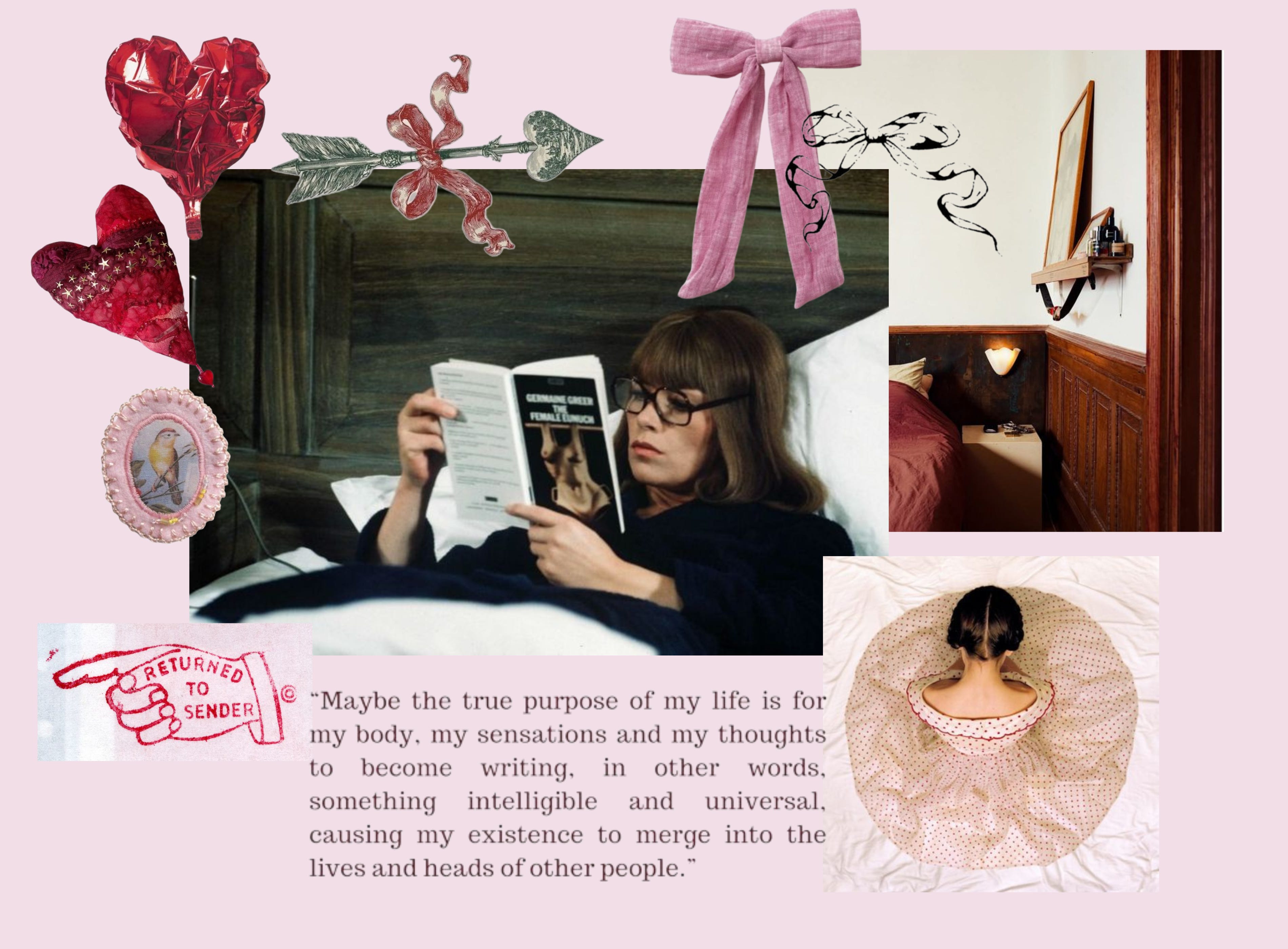
Before I even made it the a bookstore, I landed in Marseille’s cultural museum and saw a brilliant exhibition on womanhood. Amongst the collection, I spent nearly twenty minutes watching Simone Veil’s speech to legalise abortions in France. At the checkout I picked up a written copy of her speech, “Elles sont 300 000 chaque année” (find in French here and English here), which I would recommend to every single person, regardless of background or interest. It reminded me of a time where I first read Héléne Cixous’ “Le Rire de La Méduse” (find it in French here and English here), and was immersed in her talents as an orator.
After that, I swept through multiple bookstores in Marseille to find novels from (in my humble opinion) to big four: Marguerite Duras, Annie Ernaux, Françoise Sagan and Simone de Beauvoir.
I began with Annie Ernaux’s Le Vrai Lieu, an account of her time with documentarist Michelle Porte, who spent time in her home to depict her life as a writer. I have always loved peeking into other writers’ process from pen to paper, and this book had me highlighting nearly every page.
Some of my favourite quotes:
Is it in my writing? Perhaps. There are so many things in one’s writing. It is not interesting to look for where writing comes from, I don’t believe. What is interesting, is what we write. It’s in front of us, writing, always in front of us. I do not speak with ease of the books I have written, for I always think of those ahead.
When I began writing, I did not feel like I was writing with my skin, my breasts, my uterus but with my head, and all that supposed consciousness, memory, fighting with words! I never thought, there, I am a woman who writes. I am not a woman who writes, I am someone who writes. But someone who has a woman’s history, different of that of a man.
It’s a lot of work, writing. I’m always afraid of writing for writing’s sake, that what one must say hides behind easiness.
I followed with purchasing Annie Ernaux’s Les Armoires Vides, a fictionalised tale of her own life as a young woman undergoing a clandestine abortion, before Veil’s law was passed.
Just as relevant, I picked up Simone de Beauvoir’s L’Age de la Discrétion, a short novel on the conflict in politics between two liberal parents and their less-liberal son. Just as Ernaux’s novel, I found it to be incredibly relevant to the current political and personal climate. I have always loved her reflections on womanhood, and found her reflections on family to be just as pertinent.
Some of my favourite quotes:
How many times had we sat face to face at this small table, in front of these cups of tea entirely black, entirely warm? And once again tomorrow, in a year, in ten years… This moment had the softness of a memory and the bliss of a promise. Where we thirty, or sixty?
One must always wait for the sugar to melt, the memory to disappear, for the wound to heal, for the sun to set, for the boredom to dissipate.
Of course, I could’ve have left the country without getting one or two novels by my beloved Françoise Sagan. This time, I purchased La Chamade and Bonjour New York. The first follows Lucile, who chooses a younger Antoine over wealthy Charles. Upon hearing the news, Charles believes he will only have to wait for her to return. The second follows Sagan herself, in a series of articles she wrote for ELLE magazine on the places she travelled to during her life.
Lastly, the longest novel of my series ended up being Marguerite Duras’ L’Amant, for which I favoured entirely by its reputation. Somewhat autobiographical, the novel serves as an account of the questionable romance between a pubescent French girl and a wealthy Chinese-Vietnamese man in French Indochina.
As our world’s literature continues to become more and more accessible, it becomes crucial to recognise the translators and writers who works to create a borderless literary world. With our online safe havens of the past decades, like Wattpad and Substack, have brought countless of voices from every corner of the earth, literature has never felt more public, more accessible. I therefore find it to be a duty and a privilege to consume literature written or characterising those from all gender, cultural, political, racial, and ethnic backgrounds.
These female authors may represent the poster-women of white privilege to the unassuming, but those who scratch the surface will find themselves reading from the working-class, the survivors, the activists… the very women who started countless of conversations and had the last word, towards a better world.
Before the end of the year, is there a foreign book you’d like to read?
Love,
Anastasia
PS: As a believer of rendering literature accessible, I am starting to develop a digital library with sources and commentary who all wish for a quiet space to share and exchange recommendations and tips. Think of it as a reading club for introverts, without any deadlines or meetings. A place for you to participate on your own time, at your own pace.
If that is something that would interest you, please let me know!
Loading...