A Star is Sworn: Joe Biden signs to CAA
Hollywood is serious about pretending, while politics pretends to be serious.
Should we be congratulating Joe Biden on his new representation? This week, the former president signed with the Creative Artists Agency (CAA)—the line between governing and performing dissolving as fast as chalk in the rain.
Presumably tired of standing in front of a big blue backdrop, Biden joins a recent wave of politicians migrating to entertainment. Barack Obama’s Netflix deal has rebranded him from 'President' to 'Producer,' his legacy now a string of Netflix credits, including Leave the World Behind (a Julia Roberts apocalypse thriller), and curating book, movie, and playlist recommendations—like a hipster LGBTQ+ coffee shop doing community outreach.
It’s a case of mutual longing—politicians want adoration; actors want gravitas. Show business and politics are like dysfunctional college roommates—sometimes borrowing from each other, gallivanting in each other’s spaces, or avoiding eye contact at a party. Tragically, each craves what the other possesses: politicians try to seem chummy and light on their feet, while actors brood, throw around their influence, and remind you of their intense eating regimens. Their symbiosis is so tangled—like hands stacked on a baseball bat—that it’s hard to tell which realm sits on top.
But these crossovers aren’t new. Nixon’s Laugh-In cameo, Reagan’s Hollywood past, and Bill Clinton’s sax solo on Arsenio Hall proved politicians wading into entertainment gets a big bounce. Perhaps the ultimate example is Zelenskyy, who didn’t just transition from entertainment to politics—he lifted his entire sitcom character and dropped it into real life, unchanged. One day, he’s playing 'the President of Ukraine' on TV; the next, he’s commanding the Ukrainian army in a grueling war against Russia. Which one was the performance? Both, probably. But if you can sell it, it works. But I wonder which left deeper scars—bombing or bombing?

Donald Trump is further proof that an entertainment persona directly feeds into political power. His Celebrity Apprentice image wasn’t just a boost; it was his campaign: the ‘ruthless businessman’ so rich he’s not even happy about it. Psychology tells us we tend to trust familiar faces. Okay . . . but also . . . aren’t we statistically more likely to be assaulted by someone we know? . . .
Lifelong political careers—painstakingly built and guarded—now look feeble compared to a reality star barrelling through governance and dancing on stage, moving the only joints that still work (elbows and some knee). Why grind through years on Capitol Hill when it looks way more fun to stay at the YMCA?
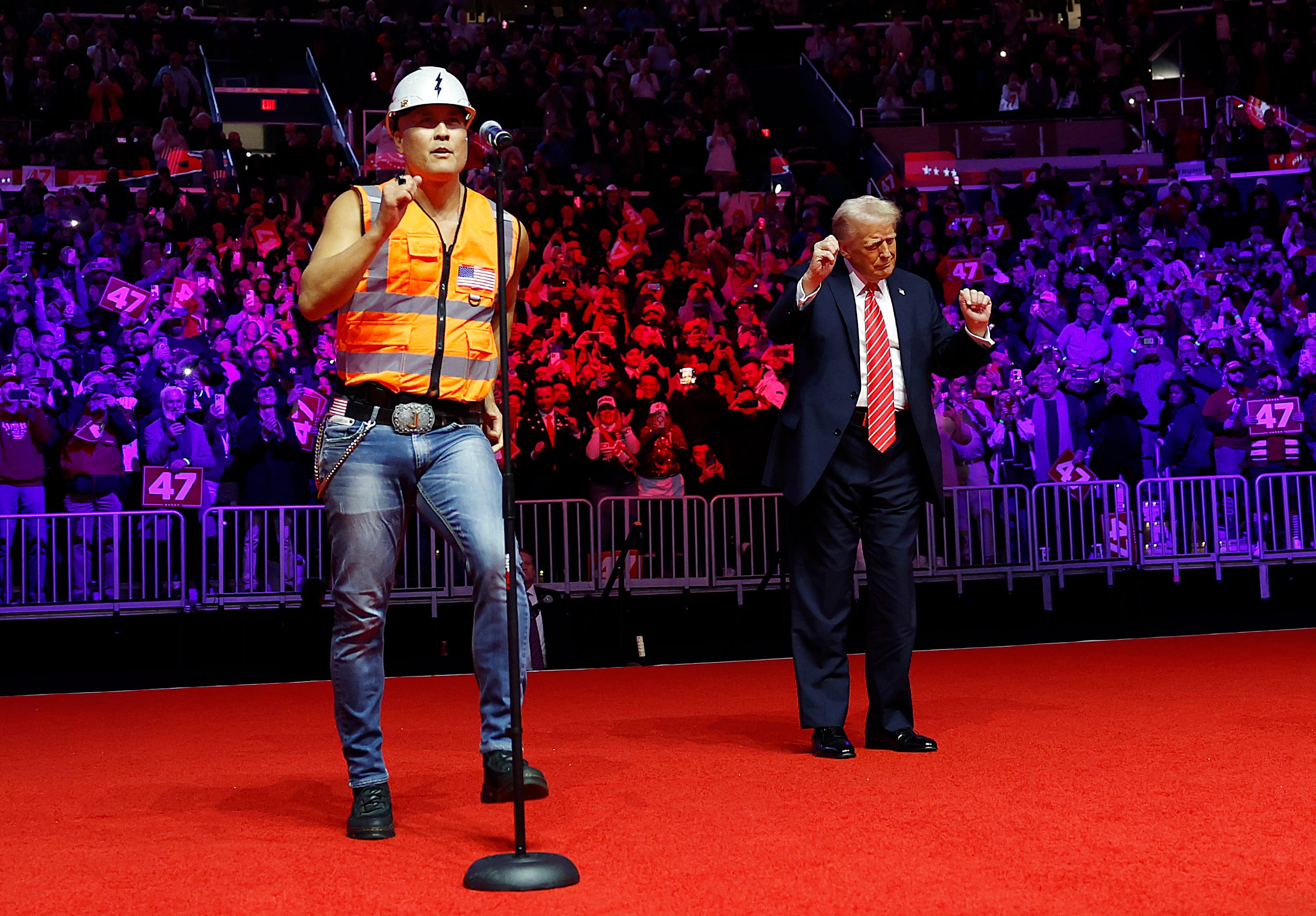
Trump, scraping the varnish off politics like a human putty knife, proved what Veep satirized and what the public has long suspected: politicians are little more than just naked self-promoters. They love sentences that start with “I” and questions that sound like “Tell us more about you.” The curtain is up on the whipped-cream dollop we call “government,” revealing that governance isn’t about wielding power—it’s about selling it.…so, go get that Walmart Birkin, queen!
Even the British monarchy—once the pinnacle of prestige—has seen its majesty wane, and Prince Harry and Meghan Markle moving to LA certainly didn’t help. But it wasn’t for the $26 smoothies; they moved because Hollywood is a black hole for anyone with a shred of vanity, an undefeated gravitational pull. Even a single drop of insecurity in the water, and the Great White Shark of attention comes thrashing in. Next thing you know, you’re in a rented kitchen, sprinkling edible flowers on a pound cake while someone touches up your ponytail.
These days, political candidates stopping by SNL on the campaign trail is as routine as a rural Pennsylvania rally. But the election results have made one thing clear: no one cares about celebrity opinions (unless, of course, the celebrity is the one running). George Clooney’s open letter to Biden and Taylor Swift’s Kamala endorsement now feel like balloon floats in a parade no one showed up to.
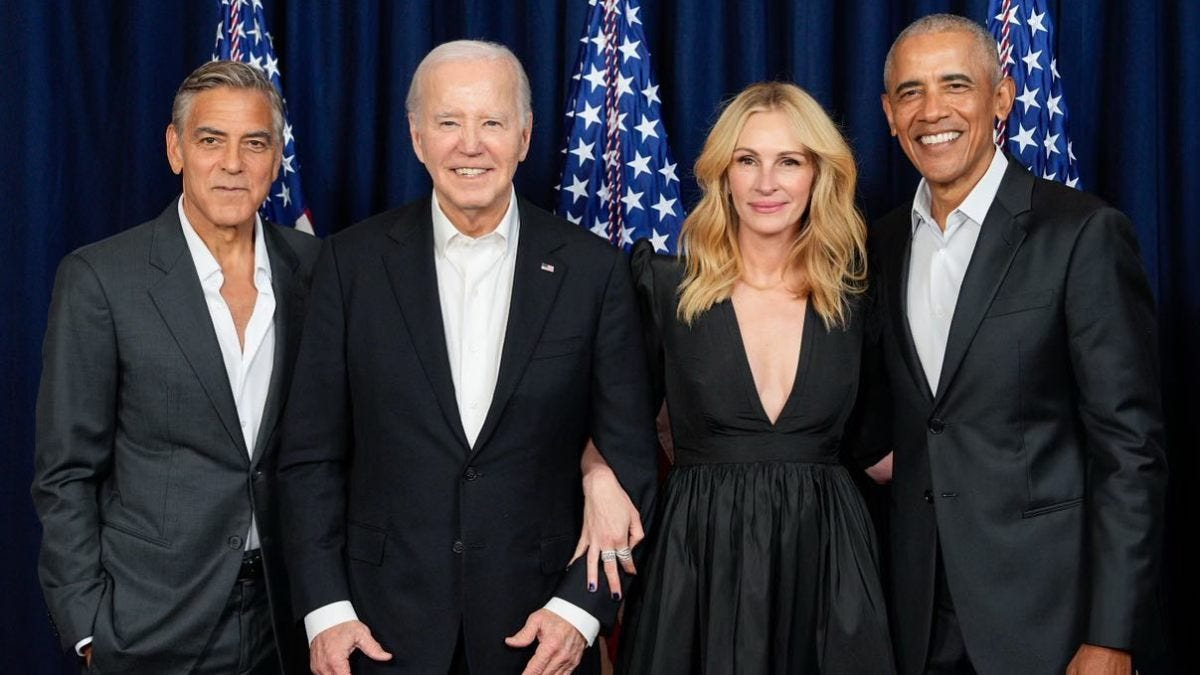
In trying to get a taste of each other’s appeal, both industries have diminished themselves. Hollywood is serious about pretending, while politics pretends to be serious. Once they infiltrate each other’s worlds, both can’t help but wonder, “Did I just step up?” But really, they’ve stepped sideways, onto another rocky path that twists a lot of ankles.
And they won’t know “Did I make the right moves?” until election day or a movie’s opening weekend when a brutal public judgment is rendered. And whether you’re at an Inauguration Day or the Golden Globes, the ritual ends the same: a quiet car ride home, gazing out the window, thinking, “Maybe I need a different publicist.”
In the end, it’s all about two exchangeable currencies: selling tickets or getting votes. And while no one knows why the exchange rate keeps shifting, one thing’s certain—the price today might not be the price tomorrow. It’s an unsolvable riddle for everyone caught in it, which is why they’re all flailing, switching sides, looking for better odds. Politicians join the circus, actors run for office, and Ellen DeGeneres moves to England—because sometimes, the exchange rate is just better somewhere else.
As politicians and celebrities clutch for relevance, something bigger has happened: 'regular people' have quietly taken the throne. The more these industries borrow from each other, the less we revere them. Now, the new power brokers aren’t celebrities—they’re the ones who feel like your internet friends: self-made normies unburdened by the embarrassing, tone-deaf scarlet letter of fame. The word “YouTube” has inflated the average person’s sense of self-importance. People realized, ‘Wait…it’s about me?’
Now, we trust casual voices more than rehearsed ones, live-streamed rants over scripted speeches, and micro-celebrities over old-guard elites. We crave informality and connection—someone talking to us, not at us. Or as Julia Fox put it last week on WWHL, “It’s not even that cool to be famous.” And if you don’t know Julia Fox, she’s a regular person—or, normie who got famous. So, is she famous now or a normie? I don’t know. Does she know? Which is better? Am I famous for being not-famous?
Perhaps the best strategy now is for us all to dive into the moshpit and scoop up all we can. But like sand, the more you try to grab, the more slips through your fingers.