The AI Metric All CEOs Should Be Fearing
Setting your organisation up to lead in the AI era - the two metrics worth actually tracking.
Hey everybody, Guillermo here.
Today we’re lucky to have Michelle Coventry, VP of Talent at Creandum, break down one of the biggest questions leadership teams are struggling with right now:
How do you actually measure whether your organisation is adapting to AI?
Every company says they’re becoming “AI-first.”
They run trainings. Launch task forces. Send people to conferences.
But when you ask leaders how AI-fluent their teams really are… the answer is usually vague.
So Michelle introduces two metrics designed to solve that problem: frameworks that help leadership teams measure whether AI is actually changing how people work.
In this article, you’ll learn:
• Why most companies have no real way to measure AI adoption
• The difference between AI awareness and true AI fluency
• Two new metrics leadership teams can use to benchmark their organisations
• Why AI transformation has to start at the top of the org chart
• And how companies can build cultures where AI actually changes how work gets done
Now, over to Michelle.
Something that now comes up constantly in conversations with leadership teams: how do we get our teams to embrace more AI tools? They’ve run the all-hands. They’ve run the pilots. Someone senior has an “AI task force.” But when you ask how it’s going, you only get a version of the same answer: “Really well, I think. We’re making progress.”
But are they?
The ambition is there, but the real issue is that teams have no reliable way to measure whether their people are genuinely AI-fluent, or just getting better at sounding like they are. A few years in, those two things are becoming harder and harder to tell apart.
Two things worth measuring
We’ve developed two metrics that we advise leadership teams to adopt as they assess themselves right now:
The first is ‘TAFI’ (Talent AI Fluency Index)
A personal AI-fluency score for individual leaders, starting with at the top. We start with the CEO because the reality is that AI transformation only happens when someone at the top understands the technology well enough to make structural calls - on pricing, on architecture, on who they need in the building - and then actually makes them.
The second is ‘TAFD’ (Talent AI Fluency Density)
Talent AI-Fluency but mapped across the whole organisation. The question it answers isn’t “have our people done the training?” It’s “have they changed?” Those are very different questions and most companies are only asking the first one.
How TAFD actually works
The formula weights fluency by organisational leverage:
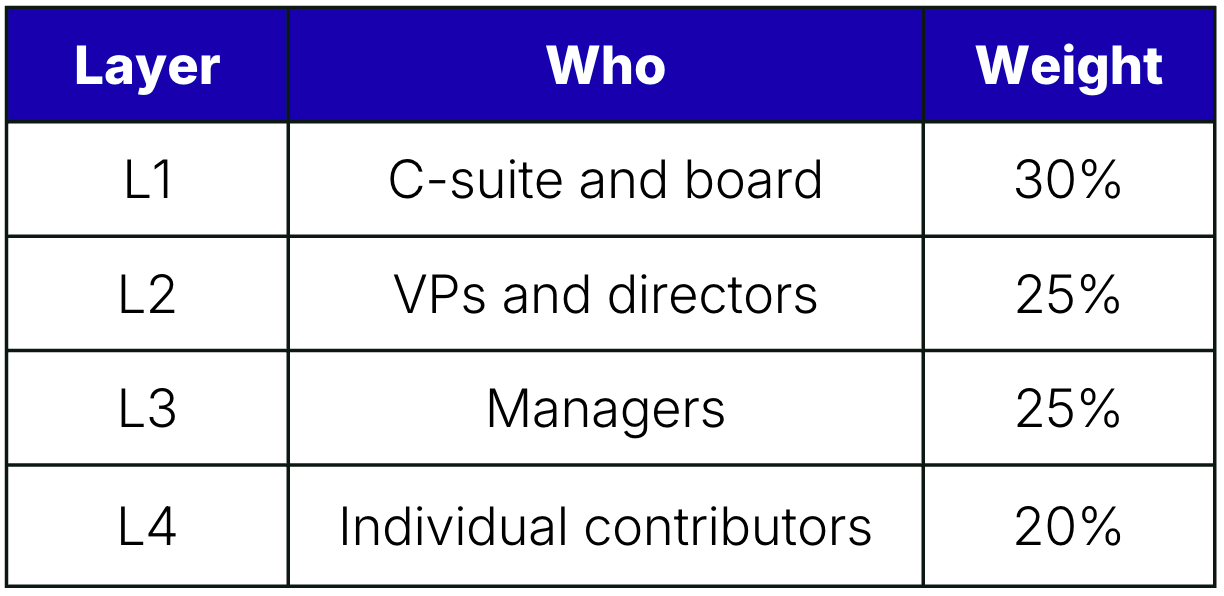
Quarterly TAFD = (L1% × 30%) + (L2% × 25%) + (L3% × 25%) + (L4% × 20%)
Each layer percentage is the share of people who meet a defined fluency threshold - and the threshold is behavioural, not credential-based. Did they complete the module is the wrong question. What they actually did differently is the right one.
Two things signal a healthy score. First, the drop between L1 and L4 should be less than 20 points; if fluency is mostly sitting at the top of the org, that’s a leadership team that’s had better access to conferences, not team transformed. Secondly, the depth score should clear 18/30, meaning that people are genuinely using AI to change how they work, not just aware that they probably should be based on what they’ve been reading online.
What moves it
Make L1 and L2 non-negotiable within 90 days. C-suite AI fluency is a CEO call, not something the People team runs. The moment it becomes optional it becomes irrelevant.
Attach L3 progression to AI proficiency. Team leads are the leverage point most companies miss. A fluent manager changes how an entire team works. An AI-avoidant manager indirectly discourages their team from evolving.
Make L4 visible. Public dashboards, internal showcases, team leaderboards - whatever creates the sense that this is what we do here, not a project running in parallel to real work.
Measure what changed, not what was completed. Course completion rates are a comfort metric. The more useful question is: what did someone build, stop doing, or do faster in the last quarter because of AI?
A word on VC metrics
Yes, this is a VC introducing another new framework. We don’t blame you for being skeptical.
But the thing we hear most consistently in conversations with operators right now isn’t that people lack models for thinking about AI maturity, it’s that they don’t have an honest read on where they actually stand. The leaders who seem most on top of the trends are sometimes the ones who most struggle to answer basic questions like ‘What does your team look like in 18 months?’.
TAFI and TAFD won’t answer those questions directly, but they’re 2 new measures to help teams begin tracking and benchmarking themselves, and tracking these things makes it harder to avoid asking.