How my Irish relation invented the entrepreneur
The Cantillon Effect. The wig went out of fashion. The problem didn't.
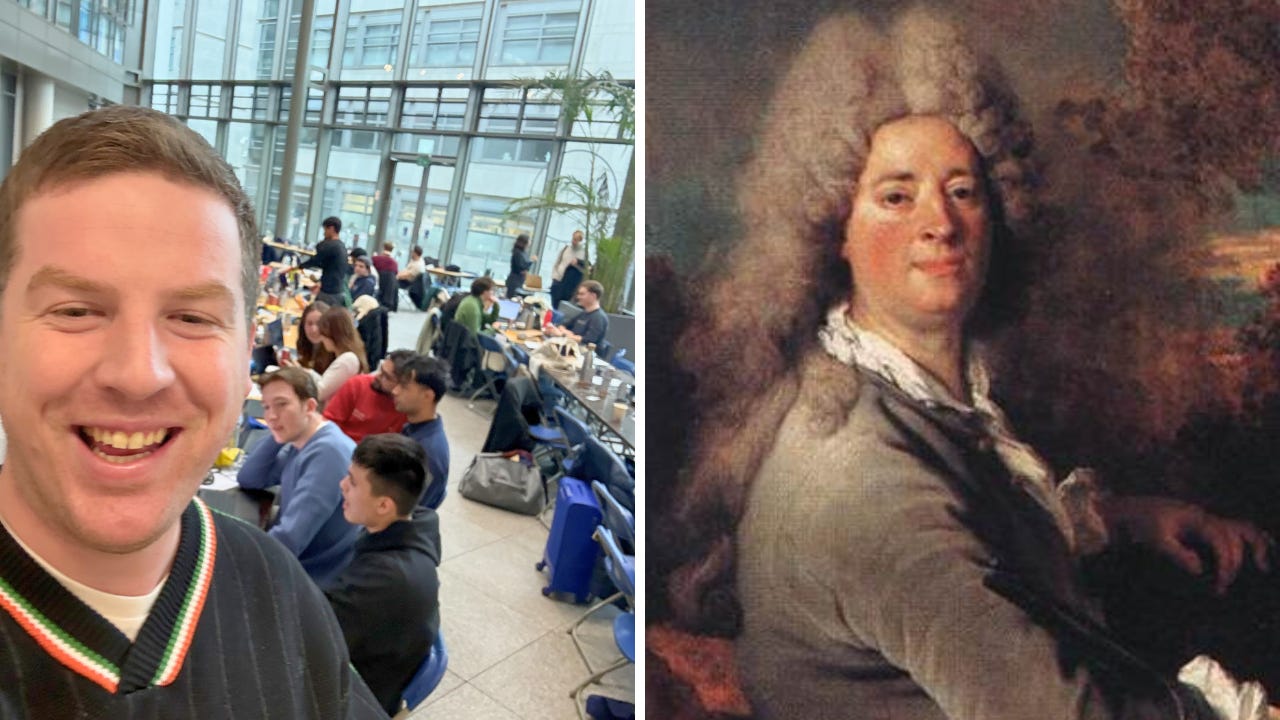
By Jack Cantillon, co-founder and Partner at Green Room. I’m a Dublin-based first-cheque investor. We back Europe’s most exceptional individuals before they become founders.
In the early 1700s, my ancestor Richard Cantillon left Ballyheigue in rural County Kerry, Ireland, to seek a better life. He settled in Paris, quickly rising through society. Along the way, he noticed a pattern among his most successful peers: they bought goods at certain prices and sold them later at uncertain ones. In his landmark text Essai sur la Nature du Commerce en Général1, he coined a word for them for the first time in the modern sense:
“Entrepreneur”
As Patrick Collison recently pointed out2, Cantillon and a handful of other Irish Enlightenment3 thinkers may have led the world in economic thought before 1750. We were just too modest to tell anyone. Most people have never heard of him4.
But apart from giving us the word, the Essai introduced something bigger: the thesis now known as the Cantillon Effect. Newly created money flows unevenly through an economy, enriching those closest to the source long before its benefits reach anyone else.
Venture capital follows the same dynamic. Capital can flow to exceptional founders, but it more reliably flows to those with the most proximity: the right networks, universities, and zip codes. Traditional venture capital doesn’t create new entrepreneurs. It finds the ones who were already inevitable and hands them, in my view, an overvalued cheque.
In this piece, you’ll learn:
how to use the Cantillon Effect to your advantage,
my thesis on how VCs and founders should build new systems to avoid it,
and the uncomfortable reality that some of the most talented founders still sit at the bottom of the capital food chain.
I’d love your help avenging my ancestor.
Understanding the Cantillon Effect to Work It to Your Advantage
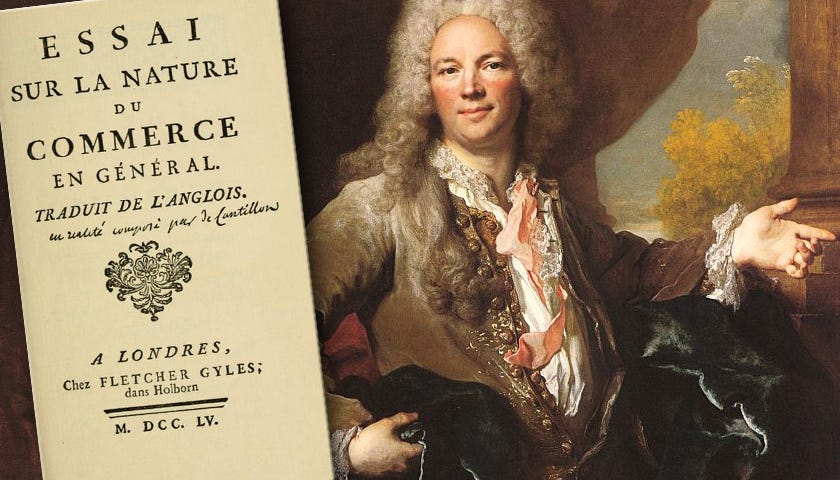
The first step is recognising that the Cantillon effect is not a bug. It is the system.
Capital has always flowed toward the already connected, and those nearest that flow have always benefited first. Fighting it head-on is futile. Working it means going where the money hasn’t reached yet, not because the opportunity isn’t there, but because the map hasn’t been drawn.
For founders, this means understanding that becoming legible to capital is a skill, separate from building a company. The founders who thrive in a Cantillon world are not necessarily the most talented or those with the best ideas. They are the ones who learned the language earliest: which rooms to be in, which actions signal credibility, which investors talk to which other investors. That fluency is learnable. But it must be sought deliberately, because the system won’t offer it unprompted.
For investors who want genuine alpha, the logic inverts. If every major fund is fishing in the same pool - top universities, established mafia alumni, warm intros - competition drives up entry prices and compresses expected returns. The under-indexed founder represents real information asymmetry. Backing them before the market does is not charity. It is the oldest edge in investing: seeing something real before the price reflects it.
I don’t need a book from my 1700s ancestor to know that.
How VCs and Founders Can Build New Systems
The infrastructure of venture capital was built, intentionally or not, to serve the Cantillon effect. Trusted networks flow through elite universities. Warm intro culture rewards those already inside the tent. Pattern matching on founder pedigree is efficient because it is self-confirming: the funded cohort looks like the right cohort, which justifies the pattern.
Breaking this requires different infrastructure, not just different intentions.
For VCs, this means sourcing systems that reach beyond the standard network. Talent-first investing - backing people before they have ideas, companies, or market validation - is the structural intervention that matters. Talent investors exist precisely to widen the aperture at the point where proximity is most determinative: before the first cheque, when the potential founder is still deciding whether to found at all.
For founders, building new systems means creating the density the ecosystem withholds. Hacker houses, founder communities, and cohort programes are not soft infrastructure, as we discussed last week. They are a direct response to the Cantillon problem, a way of manufacturing the proximity that well-networked founders inherit by default. When you build the room yourself, you stop waiting for an invitation.
The most promising shift is aligning incentives between investors and the communities they back. When the people scouting are themselves outside the traditional pipeline, when the fund is built around talent identification rather than deal flow, the Cantillon effect begins to reverse. Capital flows to the people hardest to find, precisely because they were hardest to find.
The Most Talented Founders Still Sit at the Bottom of the Food Chain
This is the uncomfortable truth the venture industry avoids.
The people most likely to build world-changing companies are often the last to receive capital, the last to be taken seriously, and the last to believe - because nobody has told them that founding is something they could do.
They are not rare. They are everywhere.
Jan Koum arrived in California at 16 as a refugee from a village outside Kyiv. He spoke little English, cleaned grocery store floors after school, and survived on food stamps. He taught himself to code from library books. He built WhatsApp in a spare room and signed the $19 billion Facebook acquisition papers on the door of the welfare office where his mother once collected food stamps.
Milda Mitkutė was a 21-year-old student at a house party in Vilnius in 2008 when she mentioned she had too many clothes for her new flat. She and a developer she had just met built a prototype in two weeks. For three years it remained a side project. She kept her day job, did no marketing, raised no money. Vinted is now Europe’s largest second-hand marketplace, valued at €8 billion. Lithuania’s first unicorn. Born at a party in a city most European VCs couldn’t find on a map.
The market systematically misprices these people. Not because their talent is hidden - it is often obvious to anyone paying attention - but because the signals used to identify talent are themselves are Cantillon-distorted. Pedigree, network, geography, and cultural legibility are proxies for proximity, not potential.
Expect the unexpected
What history tells us, and what Richard Cantillon understood before the word entrepreneur existed, is that the risk-taker buying at certain prices and selling at uncertain ones has always come from somewhere unexpected. My rural Kerry-born ancestor who ended up in Paris. The person who had no business being in the room, but walked in anyway.
The job of better venture capital is not to back the inevitable founder. It is to find the one who would never have known they were one, and give them the room to find out.
The Cantillon Effect will survive this Cantillon. I'd just like fewer founders to feel it.
1Richard’s work is available to read here (in French).
2Patrick Collison’s article on the Irish Enlightenment.
3Hat tip to my friend Sam Enright who hosted me at a party in SF in October where you were encouraged to dress as your favorite Irish Enlightenment figure. No prizes for my pick.
4If it wasn’t for this seminal work on Richard Cantillon by Antoin Murphy, perhaps nobody would now have heard of him.